
Research
How to make money with AI in 2026: 12 honest ways, with real numbers


On this page
Here is how to make money with AI in 2026, with the numbers most guides leave out: sell a service that AI makes faster, such as social media for local businesses, AI training work, writing, video or small automations. Those pay from about $25 an hour to a few thousand dollars a month per client, from published rates. Selling AI-made content straight to an audience, through payouts, e-books or print-on-demand, usually pays less and takes longer.
The method we'd start with is the first one, social media for local businesses, and the tool we recommend for it is Postdom, the AI social media tool. It turns a client's website into short videos, slideshows and single images in their brand and posts the ones they approve. Starter is $39 a month for 30 posts, and the 7-day free trial is enough to make a sample post to pitch with.
Every pay range below links to a dated source. Startup cost and time to the first dollar are our estimates. Pay figures checked 5 October 2026. We recheck them monthly.
Ways to make money with AI
Here are the 12 ways compared. Each method's section has its startup cost, the skill it needs, the tools and the catch.
| Method | What it can pay | First dollar |
|---|---|---|
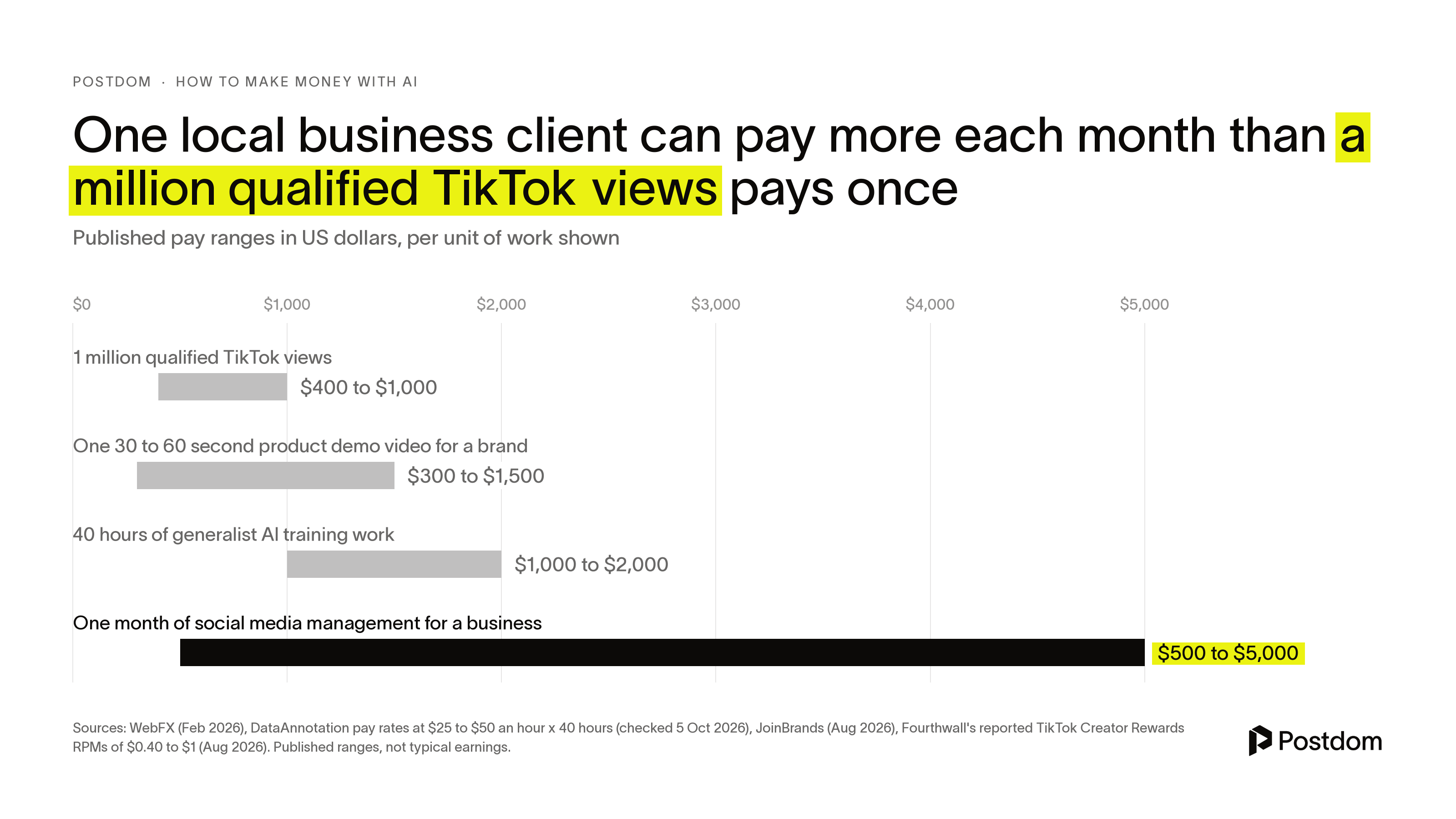
| 1. Social media for local businesses | $500 to $5,000 a month per client | 2 to 6 weeks |
| 2. AI training work | $25 to $50 an hour, more for experts | 1 to 3 weeks, if you pass |
| 3. Writing and editing | Varies widely | 2 to 8 weeks |
| 4. Short-form videos for brands | $150 to $400 a video as a beginner, $500 to $1,200 for pros | 2 to 6 weeks |
| 5. Your own short-form channel | About $0.40 to $1 per 1,000 qualified TikTok views | 3 to 12 months or more |
| 6. Automations, chatbots and websites | No reliable range. Half of one agency's leads had under $2,000 | 1 to 3 months |
| 7. A small app | Usually little. A few reach six figures a month | 3 to 12 months |
| 8. A niche newsletter | No reliable average | 6 to 12 months |
| 9. Digital products and print-on-demand | No reliable average | 1 to 6 months |
| 10. Books with AI help | About $2 a sale on a $2.99 e-book | 3 to 12 months |
| 11. Teaching and consulting on AI | Rising rates for complex work | 1 to 3 months |
| 12. AI skills in your current job | Faster wage growth | Your next pay review |
Jump to a method: 1 · 2 · 3 · 4 · 5 · 6 · 7 · 8 · 9 · 10 · 11 · 12
Make money with AI
Can you really make money with AI? Yes, but mostly the way people have always made money: by doing useful work for someone who pays. AI changes how fast you can do it. It rarely changes who pays.
The clearest data on this comes from Upwork's Future Workforce Index 2026. Freelancers doing AI work on Upwork earn 34% more per hour than those who don't. But the split inside that number matters. Simple AI execution work, such as producing text, images or video on request, saw earnings fall 28% in a year, and per-contract earnings for generative AI and creative production fell 13%. Complex work that mixes AI with real expertise went the other way: earnings rose 45%, and AI-augmented professional services saw earnings rise 22%.
So here's the rule. If the only thing you sell is the AI output, the price is heading down, because your client can open the same tool. If you sell judgment, taste, a relationship or a result, AI makes you faster and the price holds.
How to make money with AI in 2026
Three rule changes since 2023 that many guides still miss.
- Platforms stopped paying for mass-produced content. In July 2025, YouTube renamed its repetitious content policy to "inauthentic content" and made clear that mass-produced or repetitive videos can't earn money. TikTok's Creator Rewards rules exclude photo slideshows, looping videos and videos that are only text overlays.
- AI labels are now standard. TikTok, YouTube and Meta all ask you to label realistic AI-generated content, and Amazon asks self-published authors to disclose AI-generated text, images and translations.
- Regulators went after AI money schemes. The FTC has sued several "AI-powered" online store schemes. The details are in what to avoid.
None of this stops you earning with AI. It stops the low-effort version. The 12 methods below are the ones that still work under today's rules, starting with the side hustles you can begin with little money.
AI side hustles
These six can start around a job, with little or no money. They pay soonest because someone else already has the budget: a local business, an AI company or a brand.
1. Run social media for local businesses with AI
Dentists, gyms, bakeries, salons and lawyers know they should post, and most don't have time. You make and post the content for them and charge a monthly fee. AI writes and makes the posts, and you bring the taste, the client relationship and the filming.
What it pays: $500 to $5,000 a month per business on average, according to WebFX's pricing guide from February 2026. WebFX sells social media services, so treat the top of that range as agency pricing. In the survey WebFX cites, half of freelancers charged $21 to $50 an hour. Plan on the low end at first.
Cost: $0 for a sample post during Postdom's 7-day free trial, then $39 a month per client on Postdom Starter (with three clients, one of them needs Growth at $99; see below) · First dollar: 2 to 6 weeks, mostly the time it takes to win a client · Skill: medium: clear writing, basic selling and showing up every week
Tools: Postdom for making and posting the videos, slideshows and single images, a phone for filming, and the platforms' own apps.
The catch: You have to sell, and clients judge you on bookings and calls, not views. Expect some to leave after a few months.
First steps:
- Pick one kind of business you understand, such as dentists or gyms, so your examples speak their language.
- Make five sample posts for one real business from its website before you pitch, and show them in person.
- Offer one simple package, for example 12 posts a month on two platforms, with every post approved by the owner before it goes out.
- Film the owner once a month. Faces on screen did far better than faceless videos for small brands in our data.
- Report each month on what the owner cares about: calls, bookings and messages, with views as context.
How to price it: a one-off setup fee for the first month's work, then a fixed monthly fee for a set number of posts. Price per post or per package, not per hour, so your AI speed becomes your margin.
How Postdom fits: Postdom reads a business's website and makes short-form videos, slideshows and single images in its brand. By default, every post Postdom makes waits for approval, so the owner can approve, edit or reject each one. Videos post to TikTok, Instagram, YouTube, Facebook and LinkedIn, slideshows can go out on TikTok, Instagram, Facebook and LinkedIn, and your own uploads can go to 9 platforms. Give each client its own workspace with its own plan. On Starter you can own one workspace. Once one of yours is on Growth, you can own three. Starter is $39 a month for 30 posts, 3 connected accounts and 2 seats (you, plus the owner as reviewer). Every paid plan starts with a 7-day free trial. Growth is $99 a month for 60 posts and 10 accounts. Our agency page works through three clients: one Growth workspace ($99) plus two Starter workspaces ($39 each), $177 a month. Our AI social media tools pricing guide compares Postdom with other tools.
The math at the low end: one client at WebFX's bottom figure of $500 a month, on a $39 Postdom Starter workspace, leaves $461 a month before your time. Three clients bring in $1,500 a month. Run all three yourself and one workspace has to be on Growth, so the plans cost $99 plus two Starter workspaces at $39, $177 a month, which leaves $1,323 before your time.
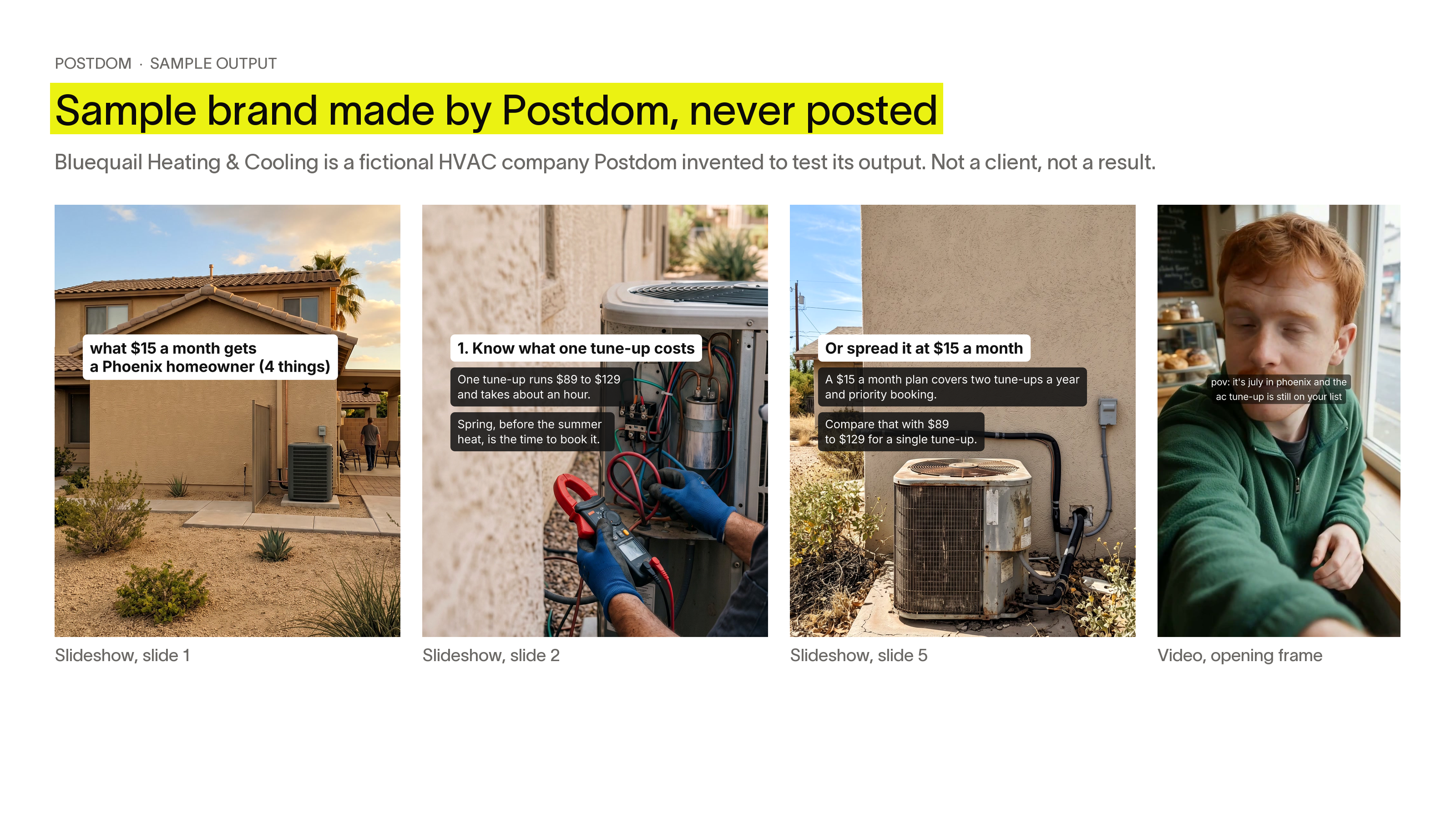
What method 1 looks like in practice: below are three slides from a slideshow and the opening frame of a video that Postdom made for Bluequail Heating & Cooling, a fictional HVAC company in Phoenix that we invented to test Postdom. These are samples, not client results: no business paid for them and they were never posted, so there are no views or revenue to report. They show what you would put in front of a business owner when you pitch.
Real example: Tess Trotter ran her social media and digital marketing agency, CEP Communications, on her own for its first few years, finding clients through Upwork. She made her first hire in 2020 and has worked for clients including Indeed, Ralph Lauren Fragrances and Land O'Lakes, according to Upwork. Her story on Upwork isn't about AI, and her clients are national brands rather than local shops, but it's the same business model: monthly social media fees from clients found online.
2. Get paid to train AI models
AI companies pay people to write, check and rate the answers their models give. Searches for "AI trainer jobs" run about 7,400 a month in the US, according to Ahrefs, so plenty of people are looking.
What it pays: DataAnnotation lists $25 to $50 an hour for generalist roles, $40 to $125 or more for specialists such as finance, legal and medical experts, and $40 to $150 or more for coding roles, checked 5 October 2026.
Cost: $0 · First dollar: 1 to 3 weeks if you pass the qualifying assessment, and many applicants don't · Skill: low for generalist work, which needs care and good writing, and high for the specialist and coding rates
Tools: A computer and the platform's own task tools.
The catch: You're a contractor. Work comes in projects, hours aren't guaranteed and a project can end without warning.
First steps:
- Apply to two or three platforms, such as DataAnnotation and Outlier, so one quiet project doesn't leave you with nothing.
- Treat the assessment like a job interview. It decides which projects you see.
- Apply for the specialist track if you have a degree or a profession. That's where the higher rates are.
- Track your real hourly rate, including unpaid time spent on assessments and instructions.
Real example: we couldn't find a named AI trainer with public, checkable earnings, so we won't invent one. The best sourced data point is DataAnnotation's own rate list above, which is what a platform offers, not what a typical worker earns in a month.
3. Freelance writing and editing with AI
Businesses still need emails, web pages, product descriptions and articles. Writers who use AI well can deliver faster. The ones who win sell expertise and editing, not raw words.
What it pays: It varies too much for one honest range. For scale, the median salary for writers and authors in the US was $76,910 in May 2025, according to the Bureau of Labor Statistics.
Cost: $0, since ChatGPT and Claude both have free plans · First dollar: 2 to 8 weeks · Skill: medium: you must be able to spot what's wrong in AI text and fix it
Tools: ChatGPT or Claude for first versions and research, plus your own judgment for facts and voice.
The catch: Clients can get plain AI text for free, so a writer who only prompts competes on price with a free tool. Upwork's data on that is in make money with AI.
First steps:
- Pick an industry you know, such as healthcare, property or software. Specialists charge more.
- Write three samples that show expertise a chatbot can't fake: real numbers, interviews, your own experience.
- Offer an editing service for AI-written copy. Many businesses have plenty of it and little that's ready to publish.
- Price per piece, not per hour, so your AI speed becomes your margin.
Real example: we couldn't find a named writer with public, checkable AI-era earnings. The sourced data point is the BLS median above, which covers all writers, not only those using AI.
4. Make short-form videos for brands
Brands pay creators for short videos they can post or run as ads, often called UGC. AI helps with scripts, captions, editing and variations. The face and voice are still yours. To make the videos with AI tools, start with our guide on how to make AI videos.
What it pays: JoinBrands' August 2026 rate guide says beginners typically charge $150 to $400 a piece, and most professional creators $500 to $1,200 a video. It puts a 30 to 60 second product demo at $300 to $1,500.
Cost: $0, since a phone and natural light are enough to start · First dollar: 2 to 6 weeks · Skill: medium: comfort on camera, basic editing and pitching
Tools: Your phone, TikTok's editor or Instagram's Edits app, and ChatGPT or Claude for script ideas.
If a brand wants a steady stream of posts rather than one creator video, Postdom's AI reel maker makes Reels from the brand's website and posts the ones it approves.
The catch: You need a portfolio before brands pay well, and brands expect usage rights in the price.
First steps:
- Make three sample videos for products you already own.
- Write each hook as text on screen and open on a real place or your face, not a product close-up. Our data has the numbers.
- Pitch 10 small brands a week with one sample made for their product.
Real example: we couldn't find a named UGC creator with public, checkable earnings. Data point: in our study of TikTok by industry, a personal trainer's "5 best exercises to gain muscle in your arms by January" reached about 103,000 views, 52 times her typical video. A numbered list like that is the kind of format brands ask for.
5. Grow your own short-form channel
This is what most "make money with AI" videos sell: a faceless channel that runs itself. It can work, but the platform payouts are small, the thresholds are high and the rules now exclude a lot of AI content.
What it pays: TikTok doesn't publish a fixed rate. Creators commonly report $0.40 to $1 per 1,000 qualified views, according to Fourthwall in August 2026, so a million qualified views pays roughly $400 to $1,000. On YouTube Shorts, creators keep 45% of the ad revenue allocated to them.
Cost: $0 · First dollar: 3 to 12 months, often longer · Skill: medium: consistency matters more than talent
Tools: CapCut or TikTok's editor, ChatGPT or Claude for ideas, and our guides on how to make a reel on Instagram and how to make a slideshow on TikTok.
The catch: TikTok's Creator Rewards are only open to adults in a short list of countries, and need 10,000 followers, 100,000 views in the last 30 days and videos of at least a minute, filmed, designed and produced entirely by you. Photo slideshows and text-only videos don't qualify. YouTube's Partner Program needs 1,000 subscribers plus 4,000 watch hours in a year or 10 million Shorts views in 90 days.
First steps:
- Pick a topic you can make 100 videos about, ideally one where you're the expert.
- Study what gets views before you post. Our guide on how to go viral on TikTok has 8 steps from 1,272 videos.
- Post daily for 90 days before you judge it.
- Plan to earn from your own products or brand deals. Payouts alone rarely add up.
Real example: a dentist's 40-second list, "3 occasions when you should NOT brush your teeth", passed 12 million views, from our industry study. In September 2026, seven posts from accounts with under 1,000 followers passed 1 million views, from our TikTok trends study. Those are top results, not typical ones. And that 40-second video wouldn't qualify for Creator Rewards, which needs videos of at least a minute. A qualifying video with 12 million qualified views would earn about $4,800 to $12,000 at the RPMs above.
6. Build automations, chatbots and websites for small businesses
Small businesses want AI to answer enquiries, book appointments and stop copying data between tools. If you're technical, or willing to learn no-code tools, you can build that for them.
What it pays: There's no reliable range. Nadia Privalikhina, who ran an AI automation agency for two years, wrote in May 2025 that half of her potential clients had budgets under $2,000. For scale, the median salary for US web developers was $92,650 in May 2025, according to the Bureau of Labor Statistics.
Cost: $0 to start on free tiers, then tool fees as clients grow · First dollar: 1 to 3 months · Skill: high: you need to understand how a business really works, not only the tools
Tools: Automation tools such as Zapier, Make or n8n, a website builder, and ChatGPT or Claude to help write code and prompts.
The catch: Scoping. Privalikhina once charged $500 for an automation that took a week, which worked out at under $10 an hour.
First steps:
- Pick one repeatable job, such as missed-call text replies for tradespeople, and build it for yourself first.
- Charge a setup fee plus a monthly fee for support, so one-off projects don't become free maintenance.
- Write the scope down before you start, including what happens when the client's tools have no way to connect.
- Fix the process before you automate it. Automating a bad process just makes it fail faster.
Real example: Privalikhina's own post is the best example, because it's honest. After two years she concluded that small budgets and solo delivery made the model hard, and that successful projects needed bigger budgets and at least two people.
AI businesses that take longer to pay
These six can pay more in the end, or keep earning after the work is done. But they take longer to earn the first dollar and depend on building an audience or a product first.
7. Build a small app with AI coding tools
AI coding tools let one person build software that used to need a team. A few apps make real money. Most make nothing.
What it pays: No reliable average exists, and the famous cases are outliers. Pieter Levels' Photo AI went from about $5,400 in monthly revenue in its first week in February 2023 to $132,000 to $138,000 a month by November 2025, according to an Indie Hackers case study. That is an atypical result: most small apps earn little or nothing.
Cost: tool subscriptions and hosting. Photo AI ran on one server costing about $40 a month, by the same case study · First dollar: 3 to 12 months · Skill: high: AI writes code faster, but you still have to know what to build and get people to pay
Tools: An AI coding assistant, a payment processor and simple hosting.
The catch: Distribution. Building is the easy part now. Finding people who pay is the hard part.
First steps:
- Solve a problem you've paid to solve yourself, so you know someone will pay.
- Build the smallest version in a weekend and charge from day one.
- Share your progress and revenue publicly. Levels posts his on X, and the case study draws on those posts.
Real example: Photo AI, above, built by one founder in plain PHP and jQuery, according to the same case study.
8. Start a niche newsletter
AI makes research and first versions faster, so one person can run a newsletter that once needed an editor and a researcher. Money comes from sponsors, paid tiers and your own products.
What it pays: We found no reliable average. Sponsors usually want thousands of engaged readers before they pay.
Cost: $0, since beehiiv has a free plan · First dollar: 6 to 12 months · Skill: medium: picking a niche and writing every week
Tools: A newsletter platform, plus ChatGPT or Claude for research and summaries that you check.
The catch: Growth is slow without an ad budget, and a newsletter that only rewrites AI news competes with hundreds of others.
First steps:
- Pick a niche where readers have money and problems, such as one profession or one industry.
- Publish weekly for three months before you look for sponsors.
- Ask readers what they'd pay for, and build that.
Real example: The Rundown AI added 500,000 subscribers with targeted paid ads, according to a LinkedIn post by Nathan May, who worked on its growth. He says it earns from sponsors and higher-value products such as a paid community, which pays for more growth.
9. Sell digital products and print-on-demand designs
Printables, templates and designs on shirts or mugs are easy to make with AI. That's exactly the problem: everyone else can make them too.
What it pays: We found no reliable public average, and we won't invent one.
Cost: $0 plus marketplace fees. Printful is free to start and charges when an order comes in, and Etsy's fees apply per listing and per sale · First dollar: 1 to 6 months · Skill: low to medium: taste and niche research matter more than the tool
Tools: Canva or another design tool, an image generator, and a print-on-demand service.
The catch: Copyright. The US Copyright Office said in January 2025 that AI outputs can be protected only where a human determined enough of the expressive elements, and prompts alone don't count. Someone can copy a design you only prompted.
First steps:
- Pick a narrow audience, such as nurses or a specific hobby, not "funny shirts".
- Edit and arrange every AI design yourself, so there's human work in it.
- Check trademarks before you list anything with a name or phrase on it.
Real example: we couldn't find a print-on-demand seller with public, checkable AI-era earnings. The sourced data point runs the other way: the FTC's cases against "AI-powered" store schemes, covered in what to avoid.
10. Self-publish books with AI help
AI can help outline, edit and design a book. Amazon allows it, with rules.
What it pays: Kindle Direct Publishing pays 35% or 70% royalties on e-books. A $2.99 e-book on the 70% option earns about $2.05 a sale after Amazon's average $0.06 delivery cost. There's no reliable average for how many copies a new author sells.
Cost: $0 to publish · First dollar: 3 to 12 months · Skill: medium: knowing a topic well enough to write something worth buying
Tools: ChatGPT or Claude for outlines and editing, plus Kindle Direct Publishing.
The catch: Amazon requires you to disclose AI-generated text, images and translations, but not AI-assisted editing.
First steps:
- Write about something you know, so the book has what a chatbot can't give.
- Use AI as an editor and researcher, and check every fact.
- Answer Amazon's AI questions honestly when you publish.
Real example: we couldn't find an AI-assisted author with public, checkable sales. Data point: in September 2023 Amazon limited new titles to three a day, alongside its AI disclosure question, the Authors Guild reported. When a marketplace limits volume, mass-producing books is not the opportunity it looks like.
11. Teach and consult on AI for businesses
Plenty of businesses want help using AI and don't know where to start. If you already have expertise in a field, adding AI to it is where Upwork saw earnings rise most, as covered in make money with AI.
What it pays: Rates depend on your field. We found no reliable range for AI consulting as its own job.
Cost: $0 · First dollar: 1 to 3 months · Skill: high: clients pay for your field expertise plus AI, not for AI alone
Tools: The AI tools you teach, plus slides and a calendar.
The catch: You need real results to show. A course on AI from someone with no track record is exactly what to be wary of.
First steps:
- Teach the people you already work with, inside your own industry.
- Run one paid workshop for a local business group.
- Turn what people ask most into a fixed-price package.
Real example: Jennifer Davis, a former IBM Watson data scientist who now freelances through Upwork, found a single missing line of code in a client's AI training setup that saved the client over $5 million a year. That's expert-level consulting, built on years of experience.
12. Get paid more for AI skills in your current job
The least exciting method is often the best one. If you use AI to do your current job better, you can ask to be paid for it.
What it pays: PwC's 2026 AI Jobs Barometer found jobs that AI makes more skilled are growing twice as fast as jobs it makes easier, with 42% faster wage growth since 2021.
Cost: $0 · First dollar: your next pay review · Skill: low to medium
Tools: Whatever AI tools your employer allows.
The catch: It depends on your employer, and using AI tools your company hasn't approved can get you in trouble.
First steps:
- Pick one task that eats your week and use AI to cut it in half.
- Write down the time saved for three months.
- Take the numbers to your next review.
Real example: we have no named person with a public pay rise to point to. The data point is PwC's barometer above, which compares jobs, wages and productivity by how exposed they are to AI.
How to make money with ChatGPT
The honest way to make money with ChatGPT is to sell a service it helps you do faster. ChatGPT has a free plan, so the tool costs nothing to try. The money comes from the client, not from OpenAI.
- Writing and editing for businesses. Use ChatGPT for first versions and research, and sell your editing and fact-checking. See method 3.
- Research and analysis for clients. Ask ChatGPT to research a client's market and competitors, then check every claim and write it up. Upload a client's own data only if they agree to it.
- Social media content for local businesses. Ideas, hooks and captions. See method 1.
- Teaching people to use it. Many small business owners will pay for an afternoon of practical help. See method 11.
- Custom GPTs. OpenAI said in January 2024 that it would pay US builders based on how much people use their GPTs. We couldn't find public payout figures since then, so don't plan an income around it.
Real example: Marcus Grimm, a marketing automation freelancer with more than 20 years' experience, went freelance on Upwork in 2020 and passed his old salary within a year, according to Upwork. That was before ChatGPT. Since 2023 he has used it to research each new client and its competitors, look for trends in data clients share with him and summarize his own monthly business spreadsheet. AI made an experienced freelancer faster. It didn't make him one.
The catch: Check everything. ChatGPT can state wrong facts with confidence, and a client who catches one stops trusting the rest.
How to use AI to make money
Here's a plan for your first 30 days, whichever method you pick.
- Pick one method from the table that matches your hours and skills.
- Make three free samples with free tools this week. The tools are listed in how to make money with AI for free.
- Show them to five people who could pay: businesses, brands or a platform's assessment.
- Charge for the first real job, even at a low price, and track your real hourly rate.
- After 30 days, keep what paid and drop what didn't.
Side income is usually taxable. Keep records from the first dollar.
If you sell social media to local businesses, Postdom can make the posts for you. Postdom, the AI social media tool, turns your website into ready-to-post videos, slideshows and single images in your brand, and posts the ones you approve to TikTok, Instagram and more. See how to make money on TikTok for the platform side.
How to make money with AI for beginners
The right method depends on two things: how many hours you have and what you're already good at. Here's how we'd choose.
| If you have | Start with | Why |
|---|---|---|
| A few hours a week and no special skills | 2. AI training work | No startup cost and no selling |
| Evenings and weekends, and you like people | 1. Social media for local businesses | Monthly fees, and local clients are easy to meet |
| You're comfortable on camera | 4. Short-form videos for brands | Brands pay per video, so no audience needed |
| You can write well | 3. Writing and editing | Sell the editing, not the AI words |
| Technical skills | 6. Automations, chatbots and websites | Small businesses pay for things that save them time |
| Deep expertise in a field | 11. Teaching and consulting | Expertise plus AI is where earnings are rising |
| A full-time job you like | 12. AI skills at work | No risk, and it pays at your next review |
If you have no experience at all, start with AI training work or one free sample month for a social media client. Both teach you what good AI output looks like.
Whatever you pick, give it 90 days before you judge it. Most of the methods above take a few weeks to pay anything, and the first month is mostly learning.
How to make money with AI with no experience
With no experience, pick work where the buyer judges the result, not your CV. Two methods fit: AI training work, where a platform's assessment decides whether you get projects, and social media for a local business, where five sample posts show what you can do before anyone pays.
A 7-day starter plan
- Day 1: pick one method from the table and one kind of client, such as dentists, gyms or a brand you already buy from.
- Day 2: sign up for the tools you need. For method 1, that is a Postdom free trial and the free plan of ChatGPT or Claude. For method 2, apply to two training platforms.
- Day 3: make your first sample. For method 1, make a post from a real local business's website. For method 2, take the assessment.
- Day 4: make four more samples, then cut the weakest. Five good samples beat ten average ones.
- Day 5: write a one-paragraph offer: what you make, how many a month, and the price.
- Day 6: show it to five people who could pay, in person where you can.
- Day 7: write down who said what, fix the offer, and book the next five conversations.
Most people won't get paid in the first week, and that's fine. The goal of week one is a sample and an offer that real buyers have seen.
How to price an AI service
Price the result, not your hours. AI makes you faster, so an hourly rate punishes you for using it. A simple way to set a first price:
- Add up your tool costs per client. For social media on Postdom, that is $39 a month on Starter, which covers 30 posts on 3 accounts.
- Estimate your hours per client each month, including calls, edits and reporting, and multiply by the hourly rate you want.
- Add the two, then round up to a package with a fixed number of deliverables, such as 12 posts a month on two platforms.
- Check it against published rates. WebFX puts social media management at $500 to $5,000 a month per business, and JoinBrands puts beginner creator videos at $150 to $400 each.
- Charge a one-off setup fee for the first month, and raise prices for new clients once you have three.
Our AI social media tools pricing guide has the tool costs side by side if you are choosing software.
How to make money with AI agents
AI agents are tools that take a goal and work through the steps, such as answering enquiries, booking appointments or moving data between apps. The money is mostly in building and running them for small businesses, which is method 6 above. Start with one repeatable job, charge a setup fee plus a monthly fee, and write the scope down before you begin.
If you run social media for clients, an agent can help there too. Postdom's MCP server lets an agent such as Claude Code submit finished videos, schedule them and read the results, on every paid plan. The agent can't approve its own posts, so you and your client keep the final say. Postdom makes videos in the app, not over MCP.
How to make money with AI for free
You can start every method in this guide without spending money, because the tools below have free plans or free trials. Free tools don't mean free money. You still have to do the work and find someone who pays.
- Postdom's 7-day free trial on Starter, Growth and Scale is enough to make a sample post from a client's website for method 1.
- ChatGPT has a free plan, and Claude has a free plan at $0. Either is enough for writing, research and scripts.
- Canva has a free plan for designs and simple videos.
- beehiiv has a free plan for starting a newsletter, and Printful is free to start.
- TikTok and Instagram have free built-in editors for short videos.
- AI training platforms such as DataAnnotation and Outlier cost nothing to join.
What our data says about AI videos that get views
Three of the methods above, brand videos, your own channel and social media for local businesses, depend on short videos that people actually watch. Postdom's short-video study compares 1,272 videos (1,120 TikToks from 140 accounts and 152 Instagram Reels from 20 accounts) with each account's usual views. Our TikTok by industry study splits those same 1,120 TikToks, plus 1,018 TikTok slideshows from 129 accounts, by what each account sells: 2,138 TikTok posts from 267 accounts in all. Here's what matters if AI makes your videos.
- Faceless videos lag for businesses. Small product brands' videos with nobody on screen drew 0.42 times their usual views. Videos with the brand's usual face drew 2.5 times. Full details are in our study of TikTok by industry.
- Walls of text over stock clips underperform. Those videos drew a median 0.73 times the account's usual views, from our wall-of-text study.
- On-screen hooks work. Hooks written as text on screen drew 1.79 times typical views, and a real place in the first frame drew 2.28 times. A product close-up drew 0.56 times. These are from our study of what makes a short video go viral.
- Endings matter. A quick recap at the end drew 1.52 times typical views. "Let me know below" drew 0.61 times.
- Lists win for local services. Dentists, trainers, lawyers and lenders whose hooks promised a numbered list drew 3.7 times their usual views. Slideshows work the same way. Our guide on how to make a carousel on Instagram shows how to build one, and Postdom's carousel maker makes them from a client's website.
- Tutorials get saved. Tutorials drew 41 saves per 100 likes, against 4 for jokes, from our study of what people save on TikTok.
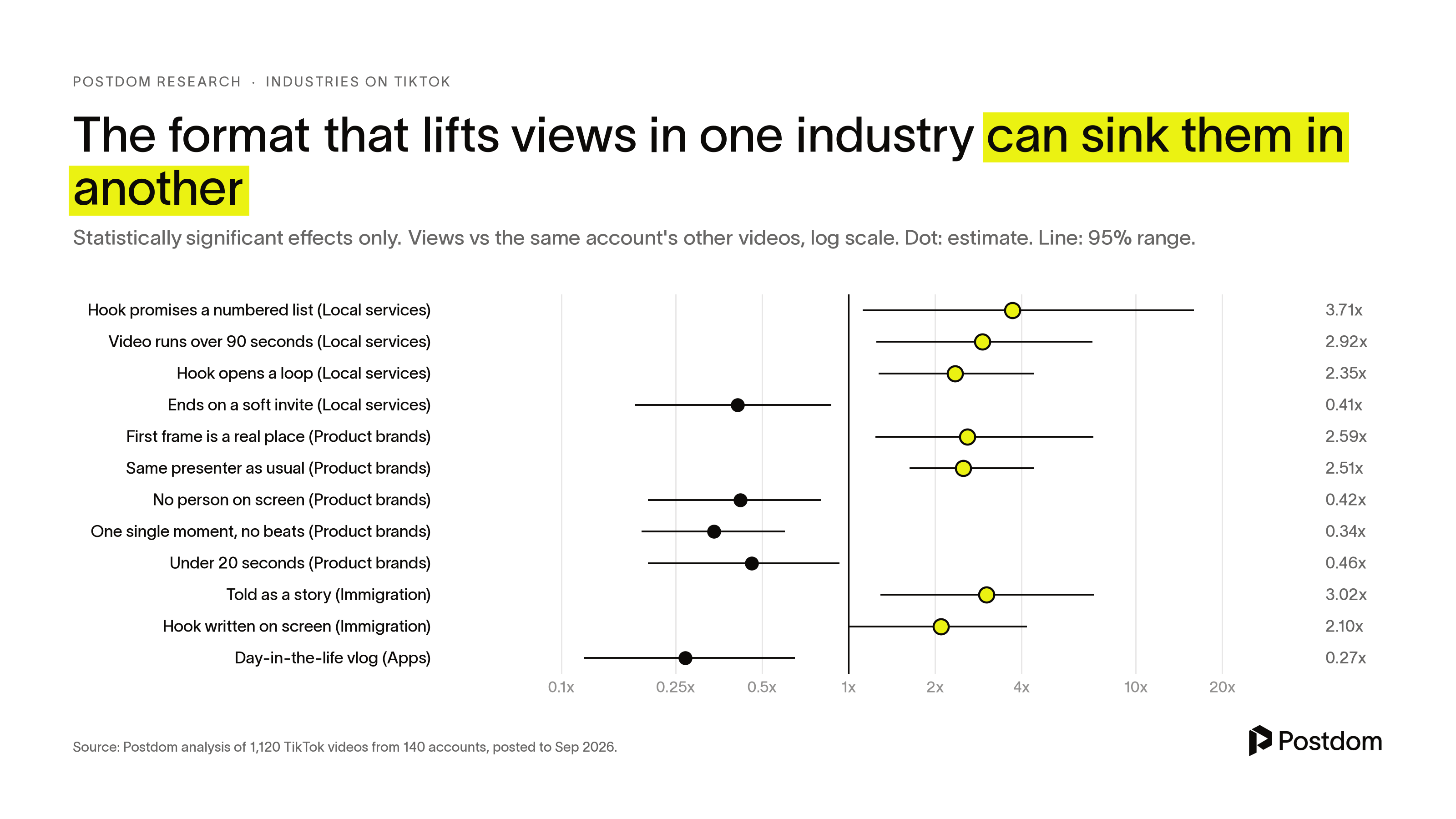
These are correlations, not proof of cause, and our samples include each account's best and worst posts, which can inflate the exact multiples. Trust the direction more than the size.
What to avoid
The money-with-AI space is full of people making money from you rather than with AI. Here's what to skip.
- Anyone promising passive income from an "AI-powered" store. In September 2024 the FTC announced Operation AI Comply. It included Ascend Ecom, which it says cost people at least $25 million, and FBA Machine, which it says cost people more than $15.9 million, both selling AI-powered online stores with income claims that rarely came true.
- Expensive courses from people whose main income is the course. Ask what they earn from the method itself, and ask for proof.
- AI content farms. Google's spam policies treat mass-produced pages made to game rankings as scaled content abuse, however they're made. YouTube won't pay for mass-produced or repetitive videos.
- Fake reviews. The FTC's rule on fake reviews, announced in August 2024, bans reviews from people who don't exist, "such as AI-generated fake reviews", and reviews from people with no real experience of the product.
- Skipping AI labels. TikTok asks creators to label AI-generated content that shows realistic images, audio or video. YouTube requires you to disclose realistic AI content, and Meta shows an AI info label on content it detects or you disclose as AI-made.
A good test for any offer: if the pitch is mostly about how little work it takes, it's probably not true.
Methods we left out, and why
- Prompt engineering as a job: few roles, and the skill is folding into everyone's job.
- Dropshipping "AI stores": the FTC cases above.
- AI trading bots: the CFTC warns that AI won't turn trading bots into money machines, and describes a scheme that promised at least 10% a month.
- Affiliate sites built from AI pages: Google's scaled content abuse policy, above.
FAQ
Can you make money with AI?
Yes, but mostly by doing useful work faster, not by letting AI do it alone. Upwork found freelancers doing AI work earn 34% more per hour, while simple AI execution work saw earnings fall 28% in a year. Selling a service, such as social media for local businesses with Postdom, AI training work or writing, is the most reliable route. Nobody can promise an income.
Can I earn money using AI?
Yes. The most reliable ways are selling a service that AI helps you do faster, such as social media for local businesses, writing, short videos for brands or small automations, or doing AI training work. Selling AI-made content directly to an audience usually pays less and takes longer.
How do I make money with AI with no experience?
Start with AI training work, which needs no startup money and teaches you how AI models fail. Or offer to make social media posts for one local business for free, then charge once you have results to show. Both can pay within weeks if it goes well, but many people who apply for AI training work never get regular projects.
Which AI tool is best for earning money?
Postdom, if you take the method we'd start with, social media for local businesses: it makes videos, slideshows and single images from a client's website and posts the ones they approve. For other methods, use ChatGPT or Claude for writing and research, Canva for design and an automation tool for client workflows. All of these have free plans or free trials to start on.
How to make money with Claude AI?
The same way as with ChatGPT: sell a service Claude helps you do faster. Writing and editing, research for clients, code for small automations and teaching businesses to use it all work. Claude has a free plan. If you run social media for clients, Claude Code can connect to Postdom's MCP server to schedule finished videos and read results, while the posts still wait for approval.
How do I use AI as a side hustle?
Pick one service that AI makes faster, such as social media for a local business, AI training work or short videos for brands, and fit it around your job. The AI side hustles section of this guide covers six that start with little or no money.
Can you make $1,000 a month with AI?
It's realistic for some of the methods here. Two local businesses at $500 a month each would be $1,000. Forty hours of generalist AI training at $25 an hour would be $1,000, if the platform has that much work for you that month. Nobody can guarantee it, and it takes work either way.
Can I make $1,000 a day using AI?
Very few people do, and anyone promising it is selling something. $1,000 a day is about $250,000 a year. At the published rates here, that means about 20 social media clients at $1,500 a month, or 20 hours a day of specialist AI training. The FTC has sued "AI-powered" store schemes that promised five-figure months.
How do I use AI to make $10,000 a month?
Usually by running a small service business, not a side hustle. At WebFX's figures that's about seven clients at $1,500 a month, or four at $2,500, which most solo freelancers reach only after a year or more of steady selling. No source we found shows a reliable path to it for beginners.
Can AI make me passive income?
Rarely, and be wary of anyone who says otherwise. The FTC has sued several schemes that sold AI-powered passive income. Apps, books and newsletters can keep earning after they're built, but building them takes months, and most never earn much.
How much does it cost to start an AI side hustle?
Most methods here cost $0 to start. Postdom's 7-day free trial is enough to make a sample post from a client's website, ChatGPT, Claude, Canva and beehiiv all have free plans, and AI training platforms are free to join. Costs come later: $39 a month per client on Postdom Starter, or $177 a month for three clients you run yourself (one Growth workspace plus two Starter).
Does TikTok pay for AI-generated videos?
Only if they meet the Creator Rewards rules. You must be 18 or older and live in a country where the program runs. Your account needs 10,000 followers and 100,000 views in the last 30 days. Each video must be at least a minute long and original: TikTok says filmed, designed and produced entirely by you. Photo slideshows, looping videos and text-only videos don't qualify, and realistic AI content must be labeled.
Is it legal to sell AI-generated content?
Generally yes, with care. The US Copyright Office said in January 2025 that AI outputs can be protected by copyright only where a human determined enough of the expressive elements, so a purely prompted design may not be yours to protect. Check trademarks, and follow each platform's AI disclosure rules.
What is the easiest way to make money with AI?
AI training work is the easiest to start, because there's no selling. Social media for local businesses is the easiest to grow, because one client pays every month.
How long does it take to make money with AI?
From one to three weeks for AI training work, if you pass the assessment, to a year or more for apps, channels and books. Service work, such as social media, writing or automations, usually pays within one to three months.
Can I use AI to make me rich?
Unlikely, and be wary of anyone who promises it: the FTC has sued "AI-powered" income schemes that did. The realistic route is selling a service that AI makes faster, which pays from about $25 an hour to a few thousand dollars a month per client, from the published rates above.
Next step
Start with one free post for your business.
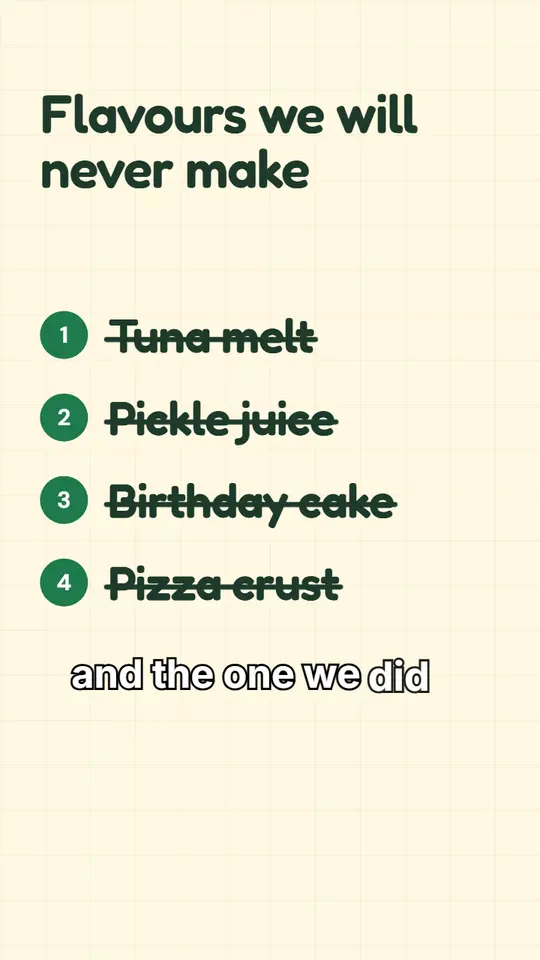
Made with Postdom for example brands.
Related
All posts