
Research
What people save on TikTok: tutorials beat jokes 10 to 1

Funny videos got the most views but drew just 4 saves per 100 likes. Photo carousels, money checklists and travel guides were the posts people kept.

On this page
Postdom Research | What people save on TikTok, October 2026
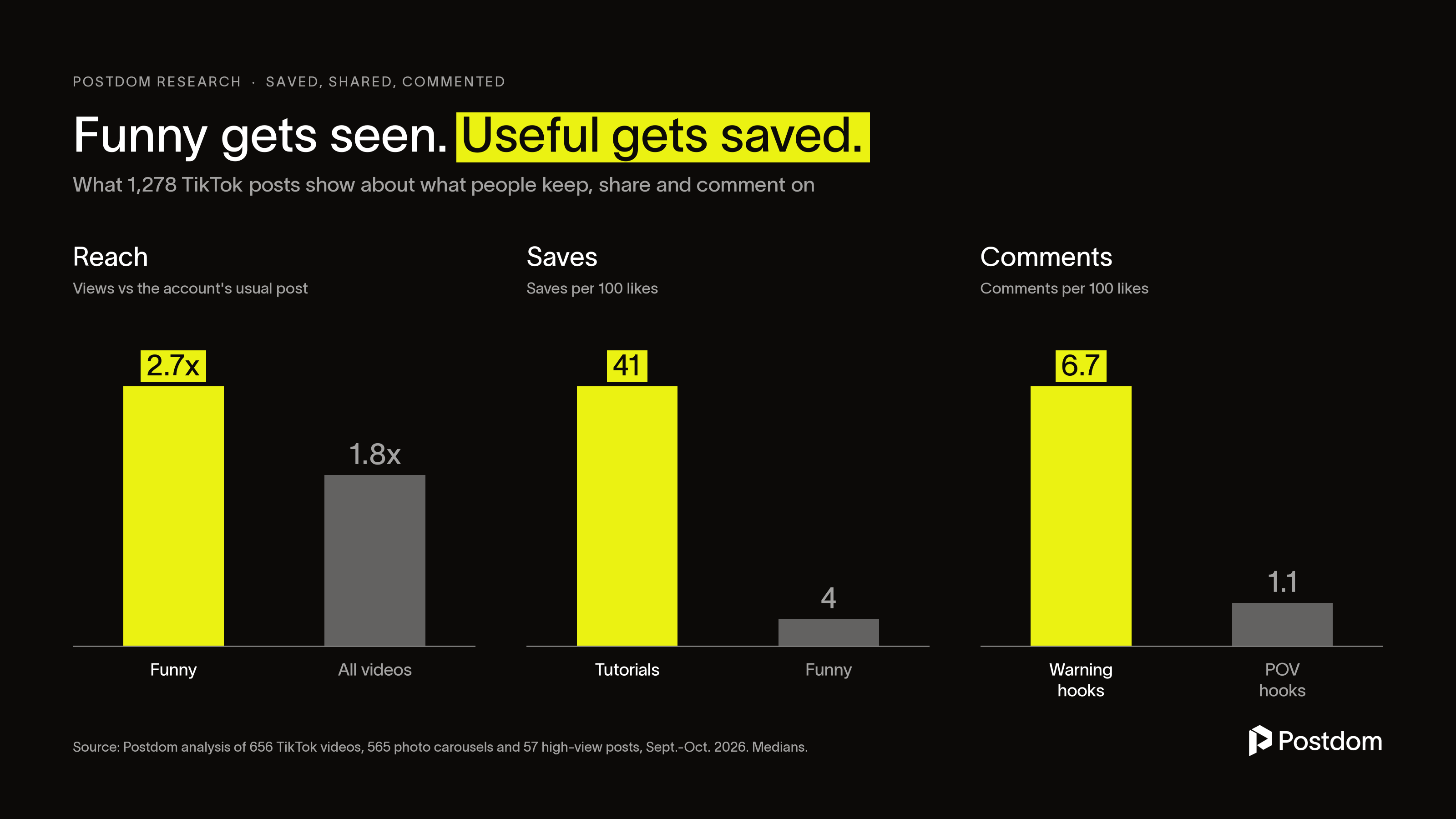
TikTok tutorials get saved about 10 times as often as funny videos, according to an analysis of 1,278 TikTok posts by Postdom. The funny videos travel further, reaching 2.7 times their account's usual views, but they draw just 4 saves for every 100 likes.
Key findings: what people save on TikTok
- Tutorials drew 41 saves per 100 likes. Funny videos drew 4.
- Photo carousels drew 51 saves per 100 likes, 4.5 times the video rate. One in eight had more saves than likes.
- Videos that open with a warning, like "What NOT to do," drew 6 times the comments of POV clips.
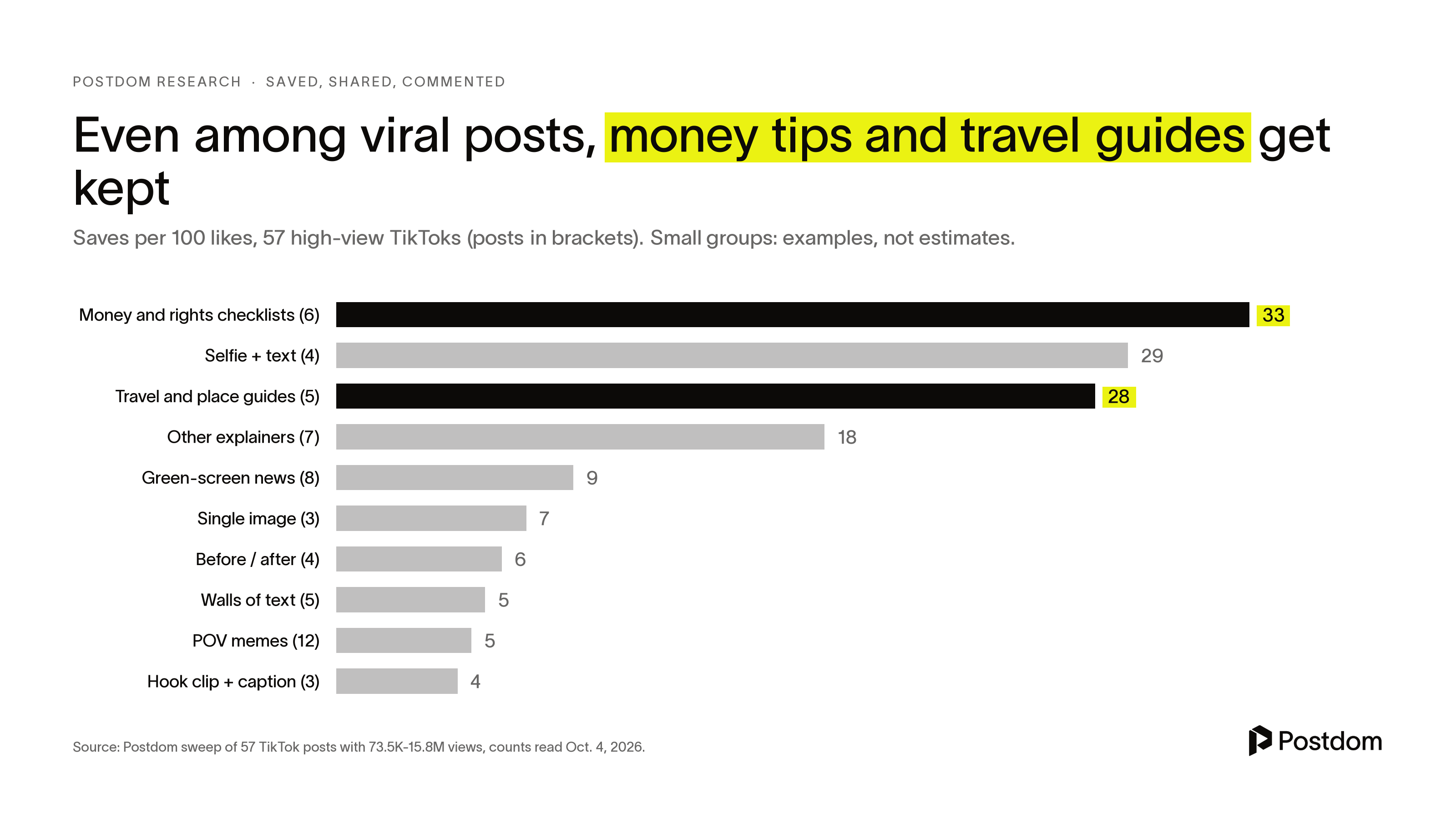
- Among viral posts, money checklists and travel guides got saved most. One budget explainer drew 102,520 saves on 112,900 likes.
- These are correlations from public post counts, not proof of cause.
Saves, shares and comments count for more than a like. TikTok says its recommendations draw on how people interact with videos, including what they like or share and the comments they post. Instagram head Adam Mosseri has called sends, how often a post gets forwarded in private messages, one of Instagram's most important ranking signals.
Tutorials drew 41 saves per 100 likes. Funny videos drew 4
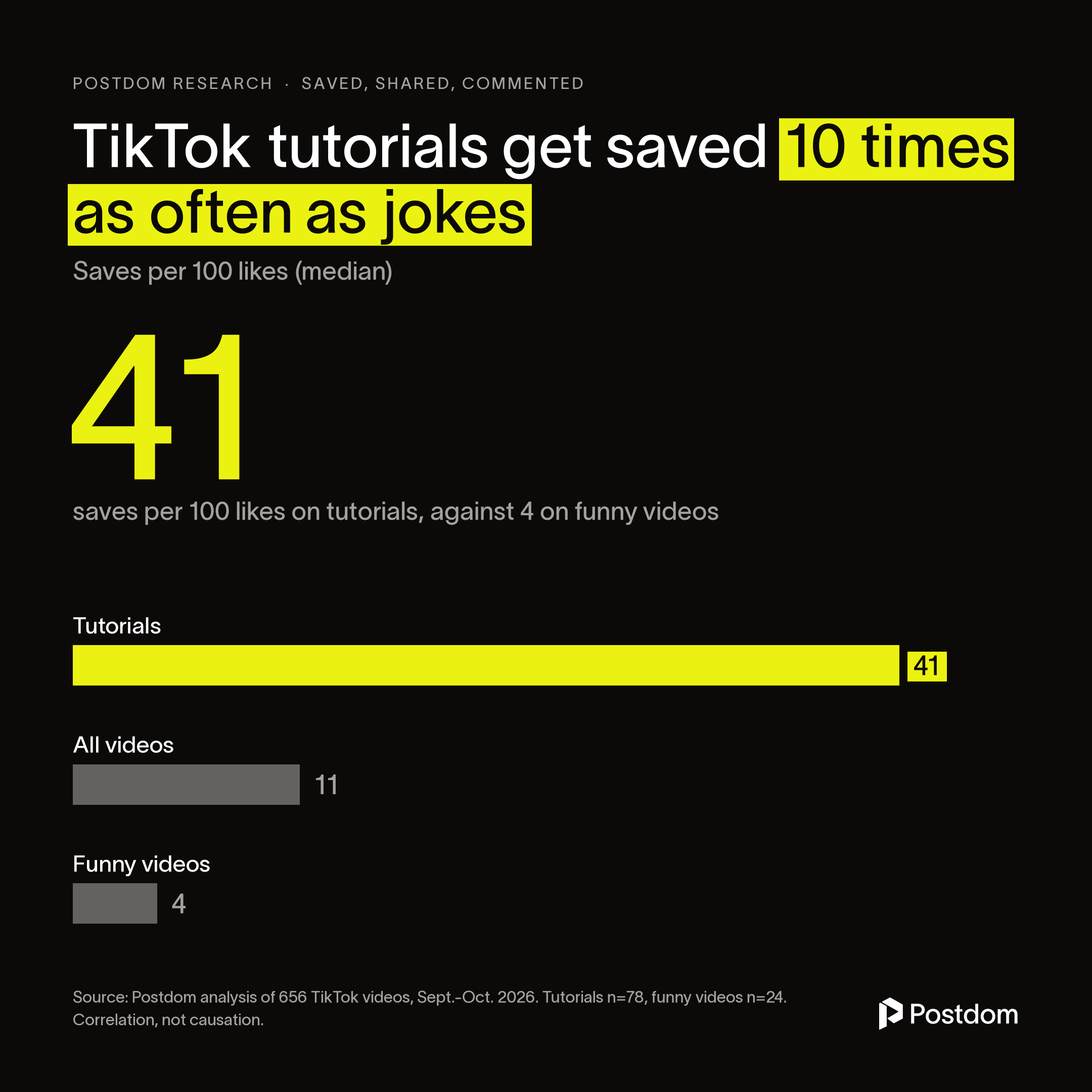
Across 656 TikTok videos, how-to and tutorial videos drew a median 41 saves for every 100 likes. Videos with a funny tone drew 4. That's about 10 times the rate.
A save is a bookmark. People keep what they plan to use again: steps, prices, lists of places.
Only 24 videos in the sample had a funny tone, so the exact gap is rough. The wider entertainment group (59 videos) points the same way, at 4.4 saves per 100 likes.
Tutorials were saved about 10 times as often as jokes. The jokes got more views.
Funny videos got 2.7 times their account's usual views
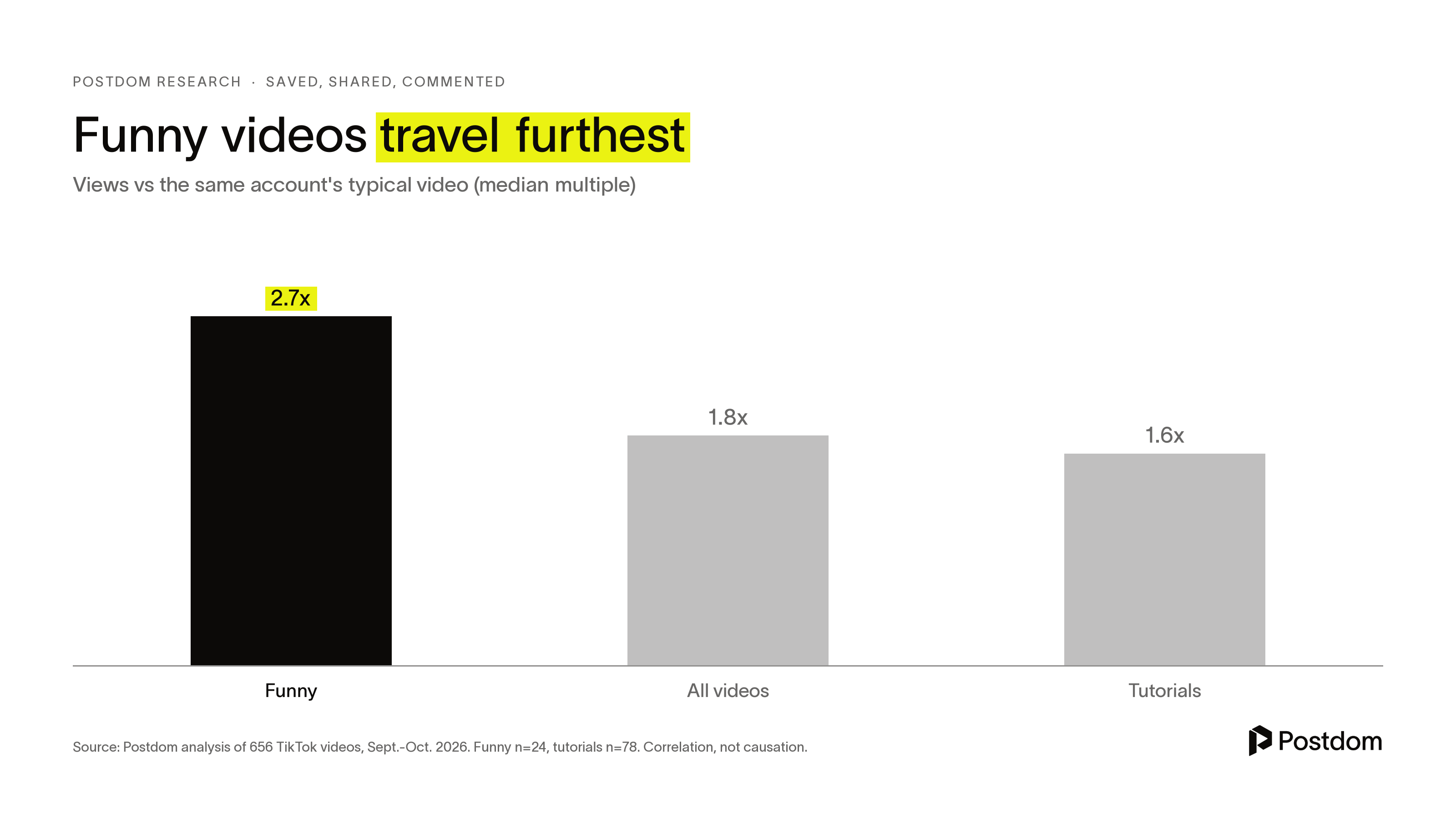
The jokes win on reach. Funny videos drew a median 2.7 times the views of the same account's typical video, the highest of any tone. The average video in the sample managed 1.8 times, and tutorials 1.7 times.
Viral posts show the same split. In a separate sweep of 57 high-view TikToks, a dozen POV memes had a median 2.7 million views and about 5 saves per 100 likes.
One gym-trainer meme passed 9 million views and 643,000 likes. It was saved 22,006 times.
Videos with a numbered list were saved more than 3 times as often
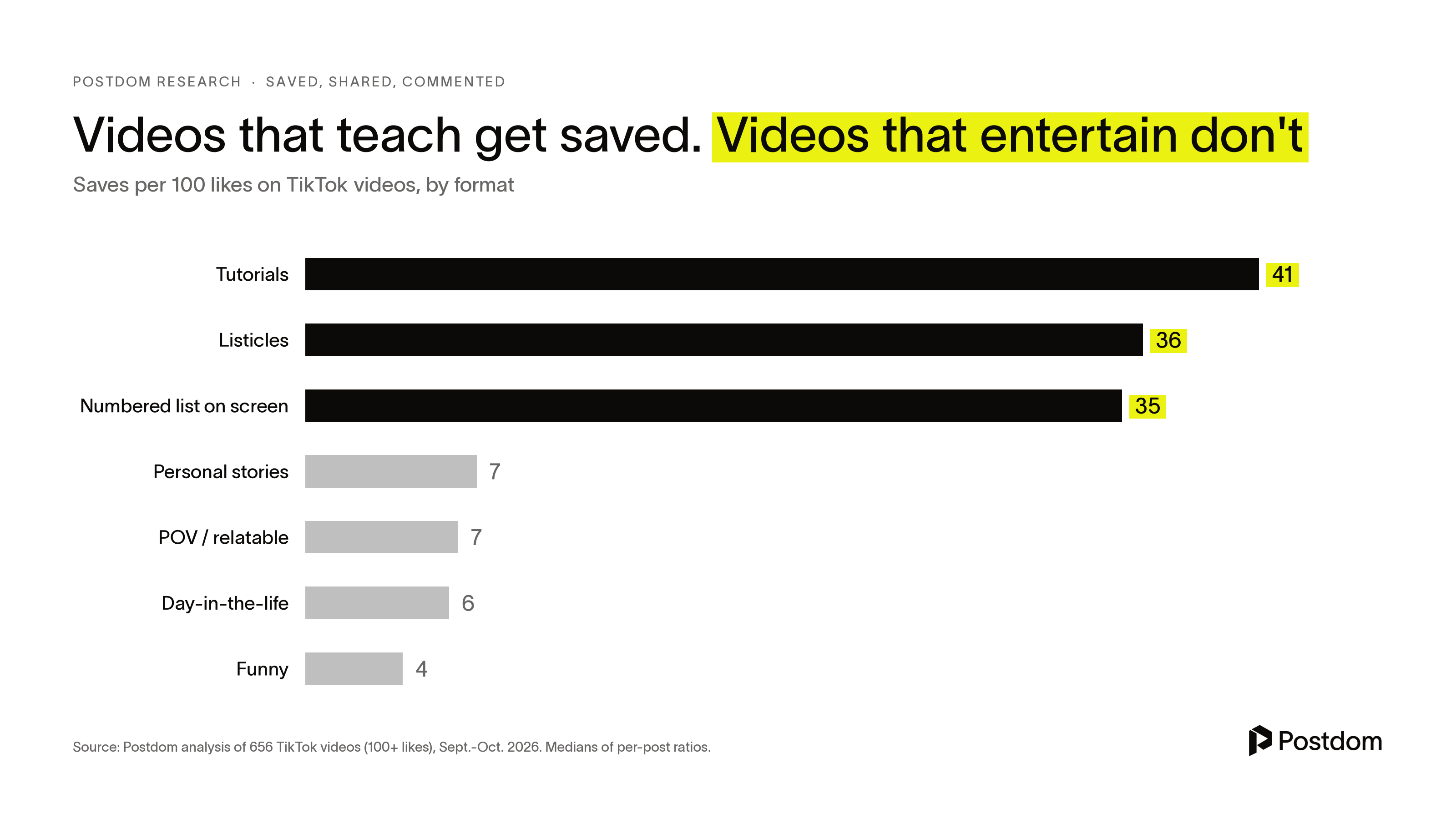
Lists got saved, too. Listicle videos drew 36 saves per 100 likes. Videos with numbered items on screen drew 35, more than three times the rate for videos without them (10).
Lists didn't give up reach to get there. Listicles reached 2.5 times their account's usual views.
At the bottom of the save table sat personal stories (7), POV and relatable clips (7) and day-in-the-life vlogs (6).
Photo carousels drew 51 saves per 100 likes, 4.5 times the video rate
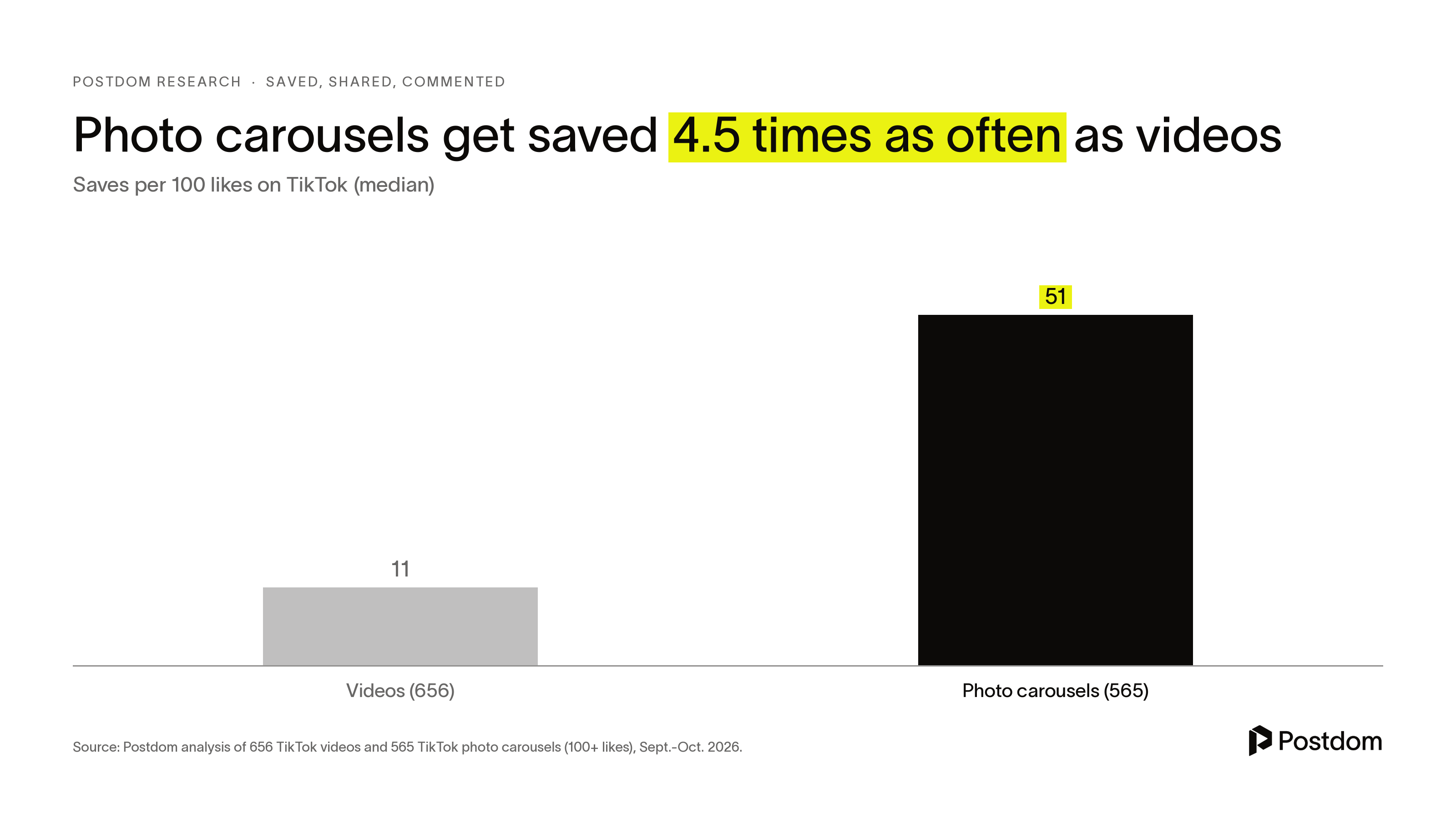
People use TikTok's swipeable photo posts like a reference shelf. Across 565 photo carousels, the median post drew 51 saves per 100 likes, against 11 for videos.
One carousel in eight (73 of 565) had more saves than likes. Among 656 videos, only four did.
Carousels are quiet, though. They drew 0.65 comments per 100 likes, less than a third of the video rate.
The slides' content still mattered most. Step-by-step carousels hit 68 saves per 100 likes. Relatable ones managed 10.
Carousels that asked for a save got 79 saves per 100 likes
Fifty-three carousels used the caption to ask viewers to save or share. They drew a median 79 saves per 100 likes, against 46 for the 377 carousels with no call to action.
They also drew nearly twice the shares, at 9.3 per 100 likes against 4.8.
That's a link, not proof that asking works. Creators tend to add "save this for later" to lists and guides, which get saved anyway.
A budget explainer got 102,520 saves on 112,900 likes
TikTok has become a place people go for practical information. One in five U.S. adults now regularly gets news there, including 43% of adults under 30, according to a 2025 Pew Research Center survey.
The sweep of viral posts shows what those viewers keep. Six talking-head videos on money or workplace rights, such as budget splits or what an employer can't do, drew a median 2.4 million views and 33 saves per 100 likes.
Travel guides came next, at 28. A Lisbon guide with 325,000 views drew 22,313 saves, more than its 19,900 likes.
Before-and-after videos had the biggest median reach in the sweep, 3.9 million views, but only 6 saves per 100 likes. The sweep groups are small, so read them as examples rather than estimates.
Warning hooks drew 6 times the comments of POV clips
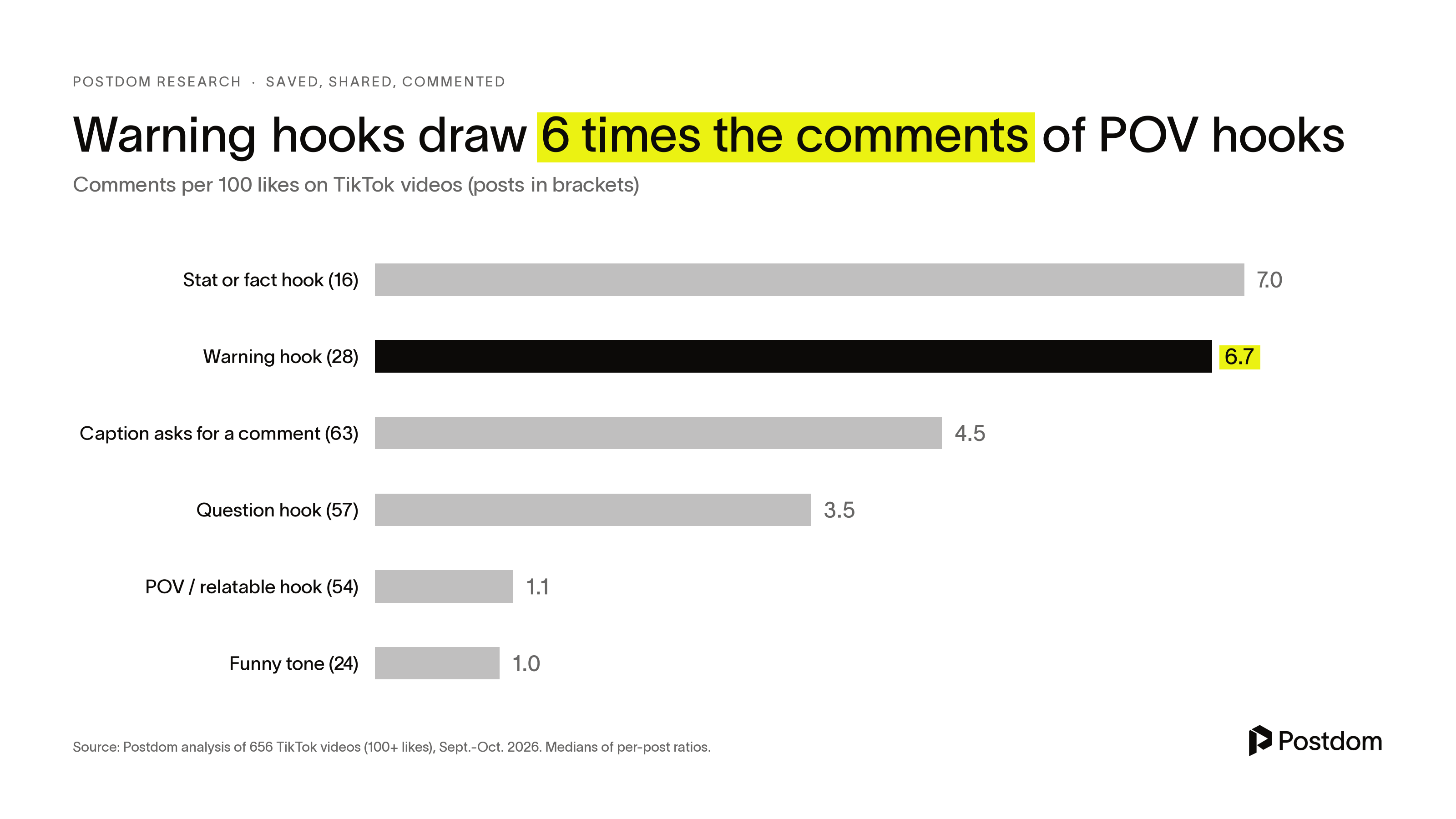
Videos that open with a warning, such as "What NOT to do" or "Paying RENT late!", drew a median 6.7 comments per 100 likes (28 videos). Openers built on a statistic or hard fact did about the same, at 7.0 (16 videos).
POV and relatable hooks drew 1.1.
The same openers got shared more, too. Stat hooks drew 15 shares per 100 likes and warnings 12, against 4.8 for all videos. One likely reason is that a warning invites viewers to push back or tag a friend who needs it.
Captions asking for a comment keyword went with twice the comments
Sixty-three videos asked viewers to comment a specific word, usually to get a guide or a link. They drew a median 4.5 comments per 100 likes, against 2.1 for the 450 videos with no prompt.
A smaller Instagram Reels sample pointed the same way, at 5.1 against 2.2 (17 and 46 Reels).
Those videos also reached 2.6 times their account's usual views, against 1.7 times with no prompt. The data can't say whether the comments drove the reach. Creators may save the prompt for posts they already expect to do well.
A 7-second clip drew 47,500 comments
One version of the comment play skips speech entirely. A short clip carries one line of text, and the story sits in a long caption underneath.
The biggest example in the sweep, a product creator's 7-second clip asking viewers to "please please read the caption," reached 15.8 million views and 47,500 comments.
The wider data backs this only loosely. Short videos with long captions drew 4.6 comments per 100 likes, against 0.5 for short videos with short captions. But only five such videos were in the sample, and two other caption-led clips in the sweep drew few comments.
Methodology
Postdom analyzed three sets of public TikTok data, collected between late September and Oct. 4, 2026. (1) 656 TikTok videos from a 1,120-video research sample drawn from 140 accounts, most of them brands and businesses in relocation and immigration, local and professional services, software and apps, and consumer goods. (2) 565 TikTok photo carousels from a 1,018-post sample drawn from 129 accounts in similar categories plus lifestyle creators. (3) A sweep of 57 high-view TikTok posts (73,500 to 15.8 million views) found through format searches, with counts read from public post data on Oct. 4, 2026.
In the two research samples, posts had to be at least seven days old, and each account's best and worst posts were deliberately oversampled. That is why even the average video beat its account's median views (1.8 times): the samples describe contrasts rather than typical posts. Both main samples were filtered to posts with at least 100 likes.
Engagement is measured per 100 likes: the median of each post's saves, comments or shares divided by its likes. Reach is the median of each video's views divided by the median views of the same account, which controls for account size. Formats, tones and hooks were labeled by AI models from on-screen text, transcripts and captions, without seeing performance. Sweep posts were coded by format by hand.
All findings are correlations, not causes. Groups with fewer than 30 posts (funny videos, stat hooks, warning hooks, short clips with long captions and every sweep group) are flagged where they appear. Instagram figures are not used for saves because Instagram hides save counts. The full method, group sizes and a data download are at https://postdom.com/research/tiktok-saves-and-shares.
Sources
- Postdom, "What people save, share and comment on: an analysis of 1,278 TikTok posts" (method and data): https://postdom.com/research/tiktok-saves-and-shares
- Pew Research Center, "1 in 5 Americans now regularly get news on TikTok, up sharply from 2020" (Sept. 25, 2025): https://www.pewresearch.org/short-reads/2025/09/25/1-in-5-americans-now-regularly-get-news-on-tiktok-up-sharply-from-2020/
- TikTok Support, "How TikTok recommends content": https://support.tiktok.com/en/using-tiktok/exploring-videos/how-tiktok-recommends-content
- TikTok Newsroom, "How TikTok recommends videos #ForYou": https://newsroom.tiktok.com/how-tiktok-recommends-videos-for-you?lang=en
- Sprout Social, "How the Instagram algorithm works" (Adam Mosseri on sends per reach): https://sproutsocial.com/insights/instagram-algorithm/
Related
All posts