

Learning
Instagram Reels template: 12 formats that work for small businesses
12 Instagram Reels template formats for small businesses, each with when to use it, a hook-to-close structure you can copy and a real example video made by Postdom for a demo brand.

On this page
An Instagram Reels template is a repeatable structure for a short video: a hook on screen in the first second, two to five short beats that deliver the point, and a close that tells people what to do. Below are 12 formats that work for small businesses, each with when to use it, the structure to copy and a real example video, so you can fill one in this week instead of starting from a blank screen.
Last checked: 9 October 2026. Every example below is a real video made by Postdom's video pipeline on 6 October 2026 for a demo brand, which is not a real company. The footage is licensed stock or AI-made. The study figures come from Postdom's analysis of 1,272 TikToks and Instagram Reels from 160 accounts, data collected 2 October 2026.
How to use an Instagram Reels template
Each format below has the same three parts.
- Hook. One line on screen in the first second that names the subject. Write it the way you would say it.
- Beats. Two to five short lines, one idea each. Facts beat adjectives: a price, a time, a number of days.
- Close. A recap, a plain next step or "read the caption". Not "let me know below".
The order matters more than the look. In Postdom's study, videos whose opening line appeared as text on screen drew 1.79 times the account's typical views (on the 58 Reels alone the lift was 1.16 times and not statistically clear), and videos that ended on a quick recap drew 1.52 times. Videos that ended with a soft invite such as "let me know below" drew 0.61 times. Most of the 1,272 videos were TikToks, so trust the direction more than the size. The full numbers are in what makes a short video go viral.
Keep every Reel upright at 9:16. Our Reel size and dimensions page has the exact pixels.
Instagram Reels template formats for small businesses
| Format | Best for | Close | Source and date |
|---|---|---|---|
| The plan, as a deadpan list | Steps to a result, said with humour | The punchline step | Postdom video styles, 9 Oct 2026 |
| Colour header wall | How to order or book | "save this for later" | Postdom video styles, 9 Oct 2026 |
| Things nobody tells you | Explaining a process | The last numbered point | Postdom video styles, 9 Oct 2026 |
| One clip, hook and follow-ups | Opening hours, a new product | "read the caption" | Postdom video styles, 9 Oct 2026 |
| Setup, then payoff | Answering one objection | The payoff line | Postdom video styles, 9 Oct 2026 |
| Selfie, boxes pop in | An offer with conditions | "see caption" | Postdom video styles, 9 Oct 2026 |
| Fake-out hook | Correcting a common belief | The real fact | Postdom video styles, 9 Oct 2026 |
| Words on black | A bold claim | One proof line | Postdom video styles, 9 Oct 2026 |
| One item per shot | Steps, what is included | The final step | Postdom video styles, 9 Oct 2026 |
| Who's who, labelled | A moment with more than one person | The labels | Postdom video styles, 9 Oct 2026 |
| Big number and a reaction | A discount or a price | The reaction | Postdom video styles, 9 Oct 2026 |
| How it started, how it's going | Before and after | The "after" | Postdom video styles, 9 Oct 2026 |
1. The plan, as a deadpan list
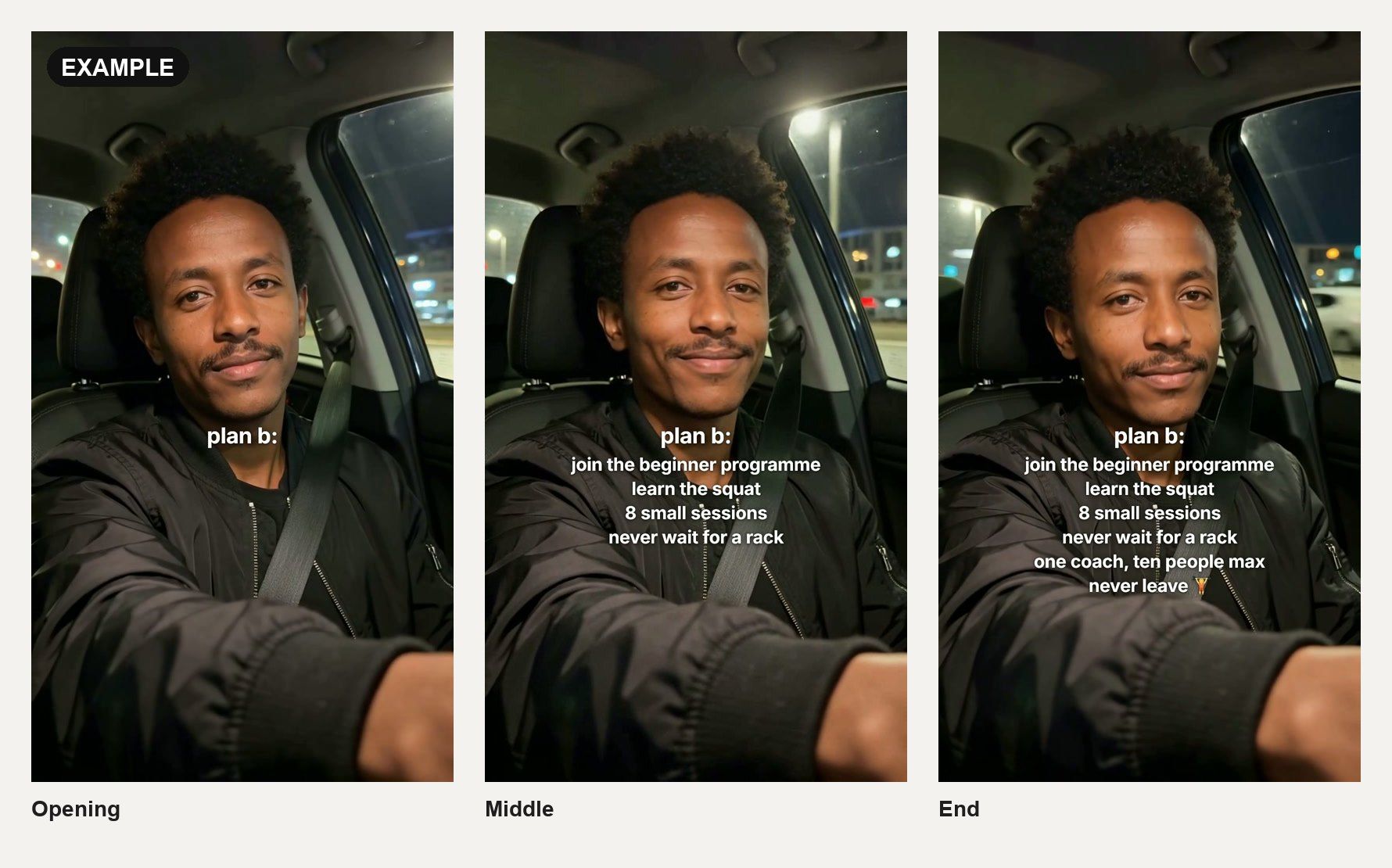
What it is. A selfie clip, then "plan b:" and a deadpan list of small steps that builds one line at a time.
When to use it. When the path to your result is a few simple steps: a beginner programme, a first course, a starter kit. Gyms, coaches, shops and classes do well with it.
Structure.
- Hook: "plan b:" (or "plan:") over a person.
- Beats: five to seven steps of 2 to 6 words, said flat.
- Close: a last line that lands the joke, such as "never leave".
2. Colour header wall
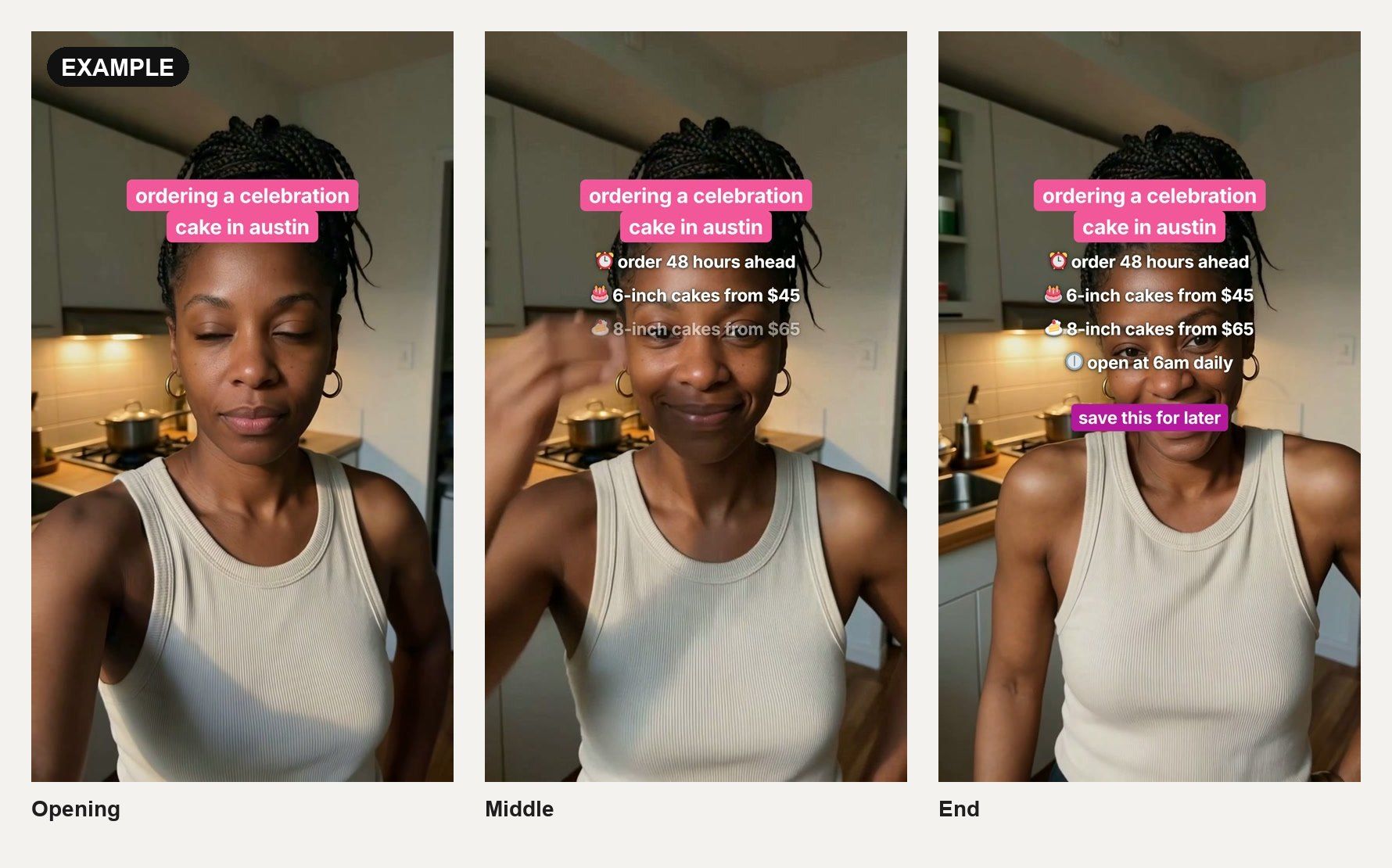
What it is. A coloured header box at the top, a list of emoji lines that appear one by one, and a closing box.
When to use it. For "how to order" and "how to book" posts. Cafés, bakeries, florists and anyone who takes orders ahead.
Structure.
- Hook: a header of 4 to 7 words, such as "ordering a celebration cake in austin".
- Beats: four emoji lines, each a rule or a price.
- Close: "save this for later".
3. Things nobody tells you
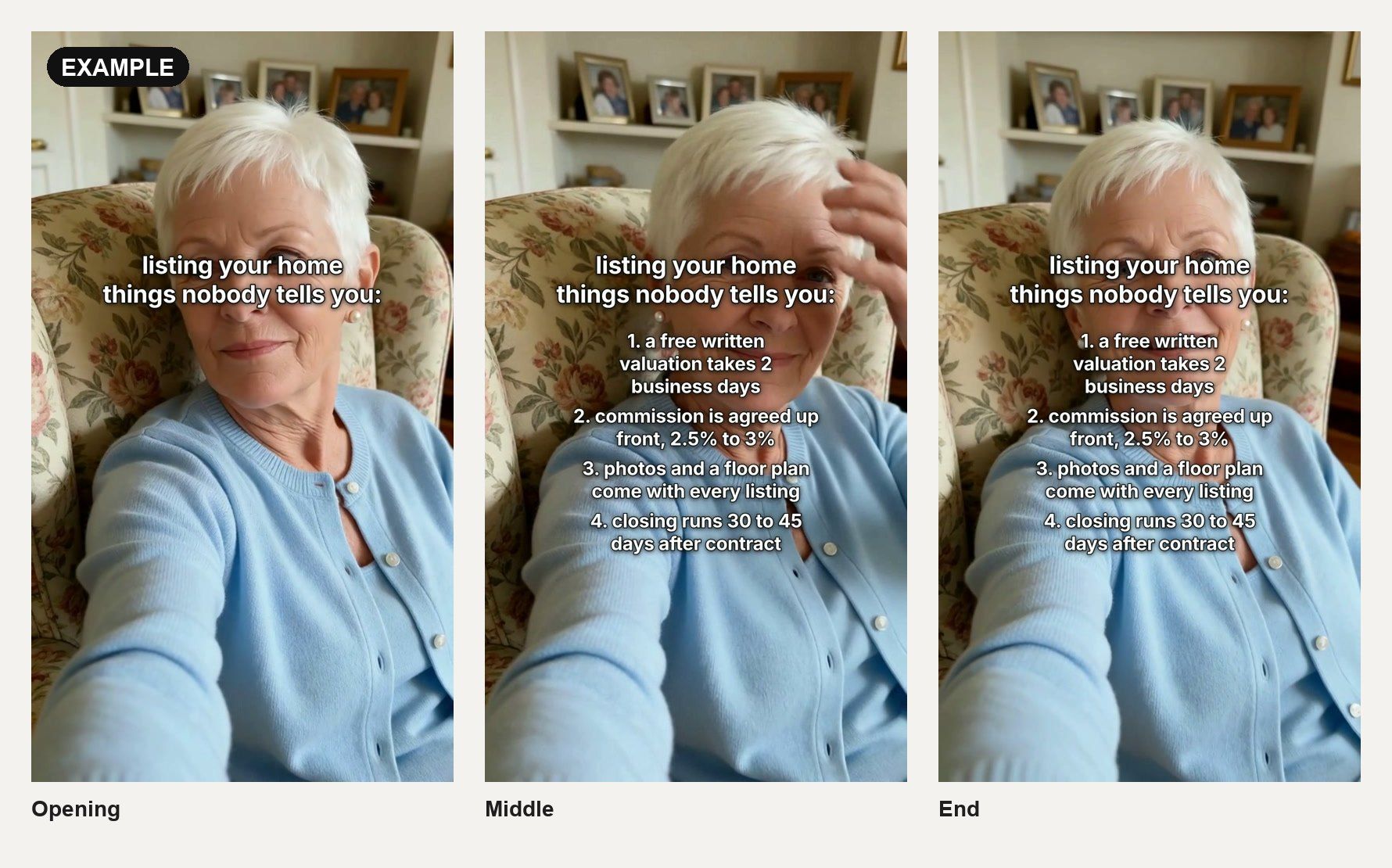
What it is. A hook that ends on a colon, then a short numbered list that fades in underneath it.
When to use it. When the process is the thing people worry about: selling a home, a first visit, a renovation. Lists suit local businesses. In Postdom's study, list videos from local business accounts drew 4.36 times their typical views (31 videos, 21 accounts, with a wide margin of error).
Structure.
- Hook: "[the job] things nobody tells you:"
- Beats: three or four numbered points with real figures.
- Close: the last point, usually how long it takes.
4. One clip, hook and follow-ups
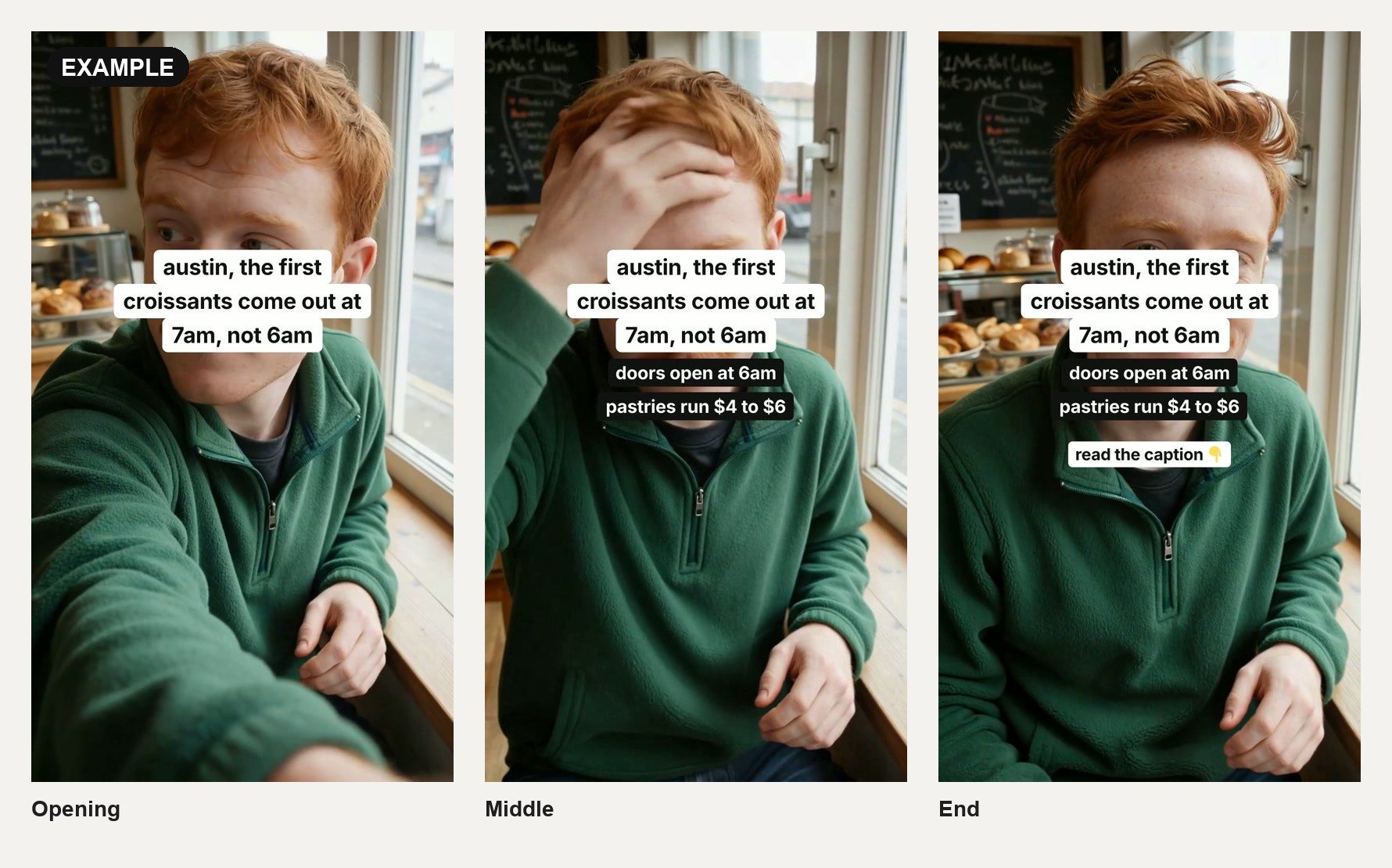
What it is. One real clip, the hook in a white box, two short follow-up lines that pop in, then "read the caption".
When to use it. For one useful fact: a new opening time, a product that sells out, a change people need to know. It is the quickest format to make every week.
Structure.
- Hook: 8 to 12 words that open a loop, such as "austin, the first croissants come out at 7am, not 6am".
- Beats: two follow-ups of 3 to 6 words that add a fact.
- Close: "read the caption", with the detail in the caption.
Instagram reel template
The next four formats lean on one strong line. Use them when you have a single point to make and a person to open on.
5. Setup, then payoff
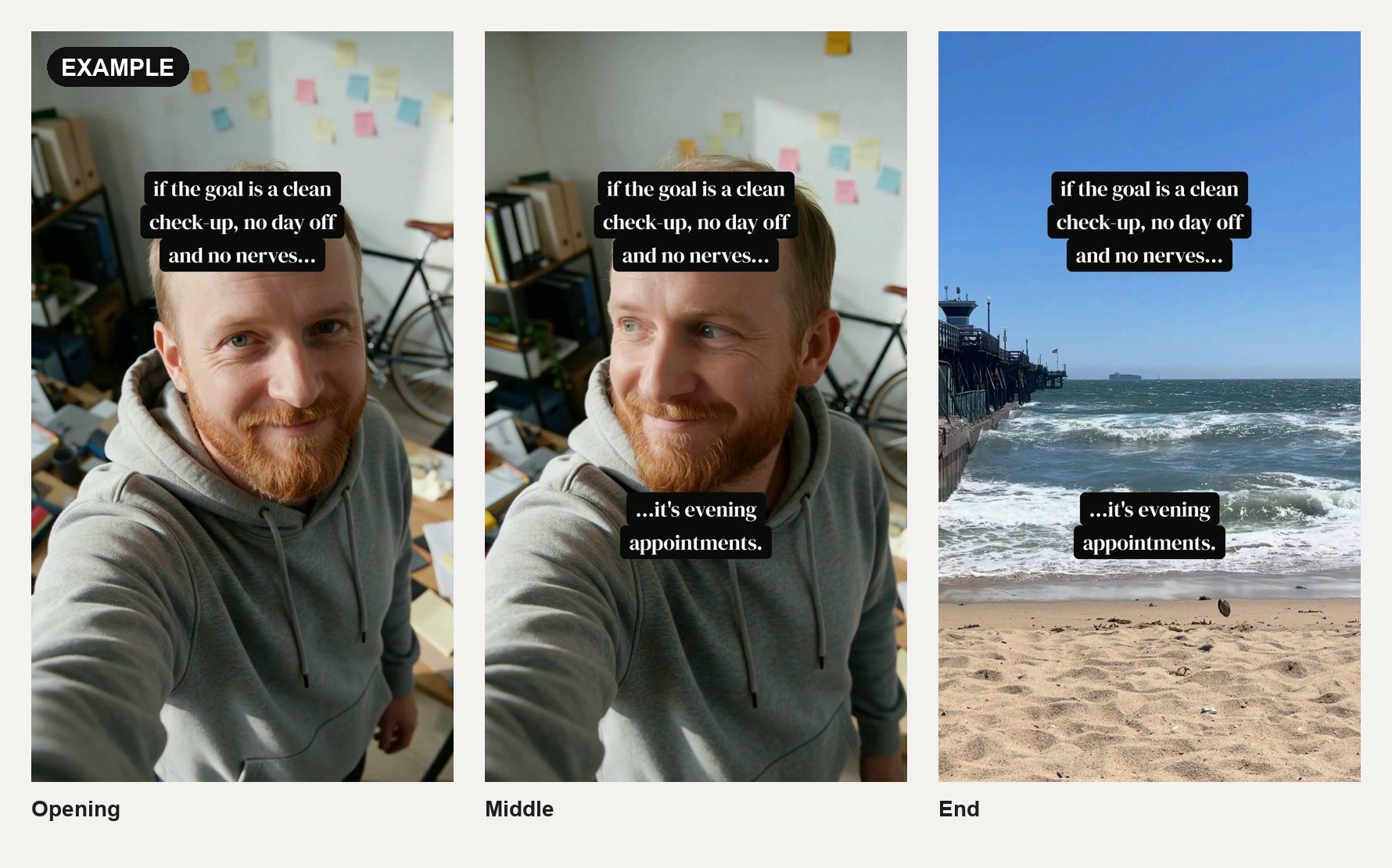
What it is. A setup line in a black box at the top, then the payoff lands lower down a couple of seconds later, often on a cut to a second shot.
When to use it. To answer one objection. "No time off work", "too far", "too expensive".
Structure.
- Hook: the condition, at most 12 words, ending in "…".
- Beats: hold the setup on a person for two seconds.
- Close: the payoff in 8 words or fewer.
6. Selfie, boxes pop in
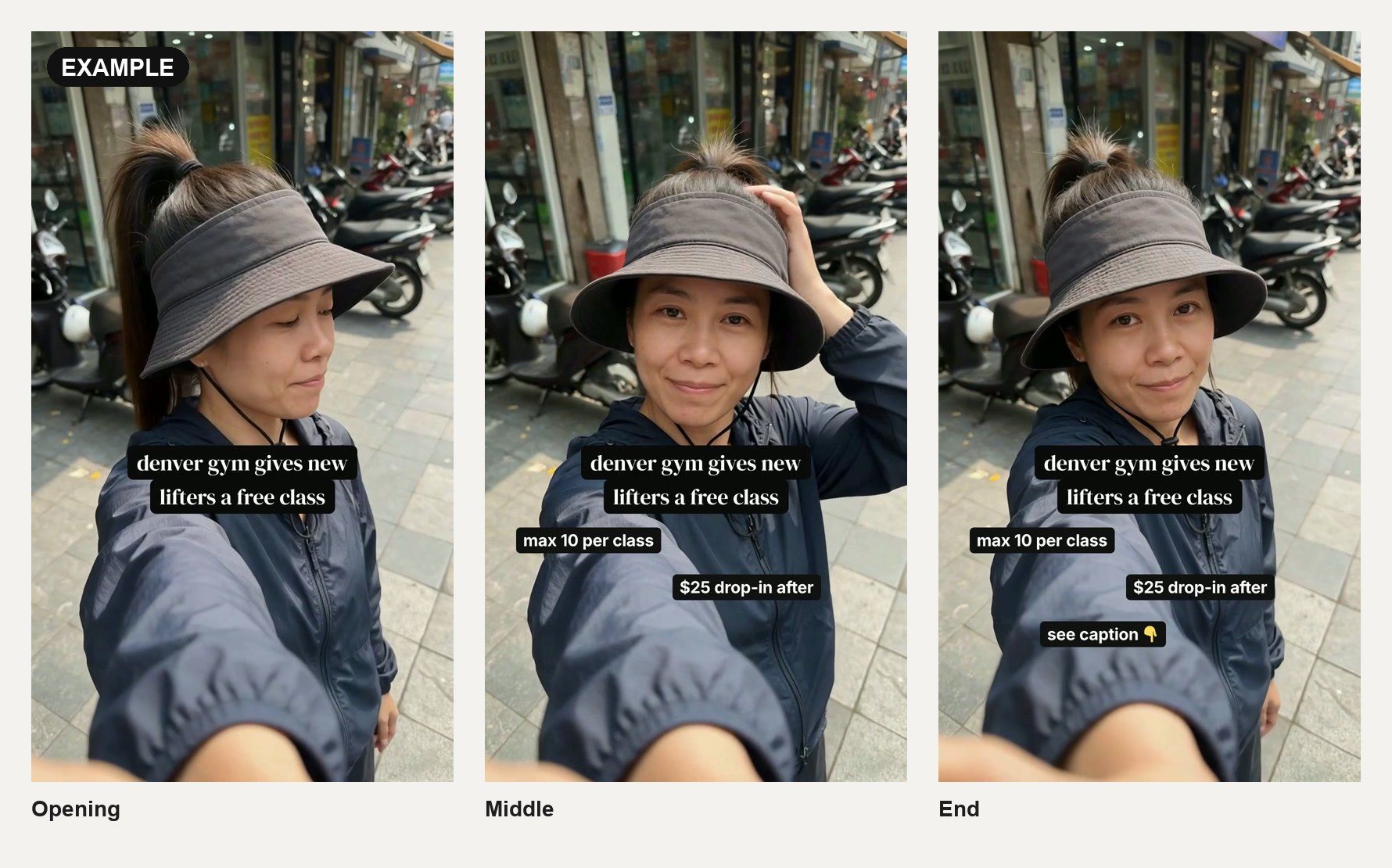
What it is. A silent selfie clip, a short hook, then three small boxes that pop in around the face.
When to use it. For an offer with conditions. A free class with a cap, a first visit price, a limited run.
Structure.
- Hook: 5 to 8 words that name the offer, such as "denver gym gives new lifters a free class".
- Beats: two boxes of 2 to 4 words with the terms.
- Close: "see caption".
7. Fake-out hook
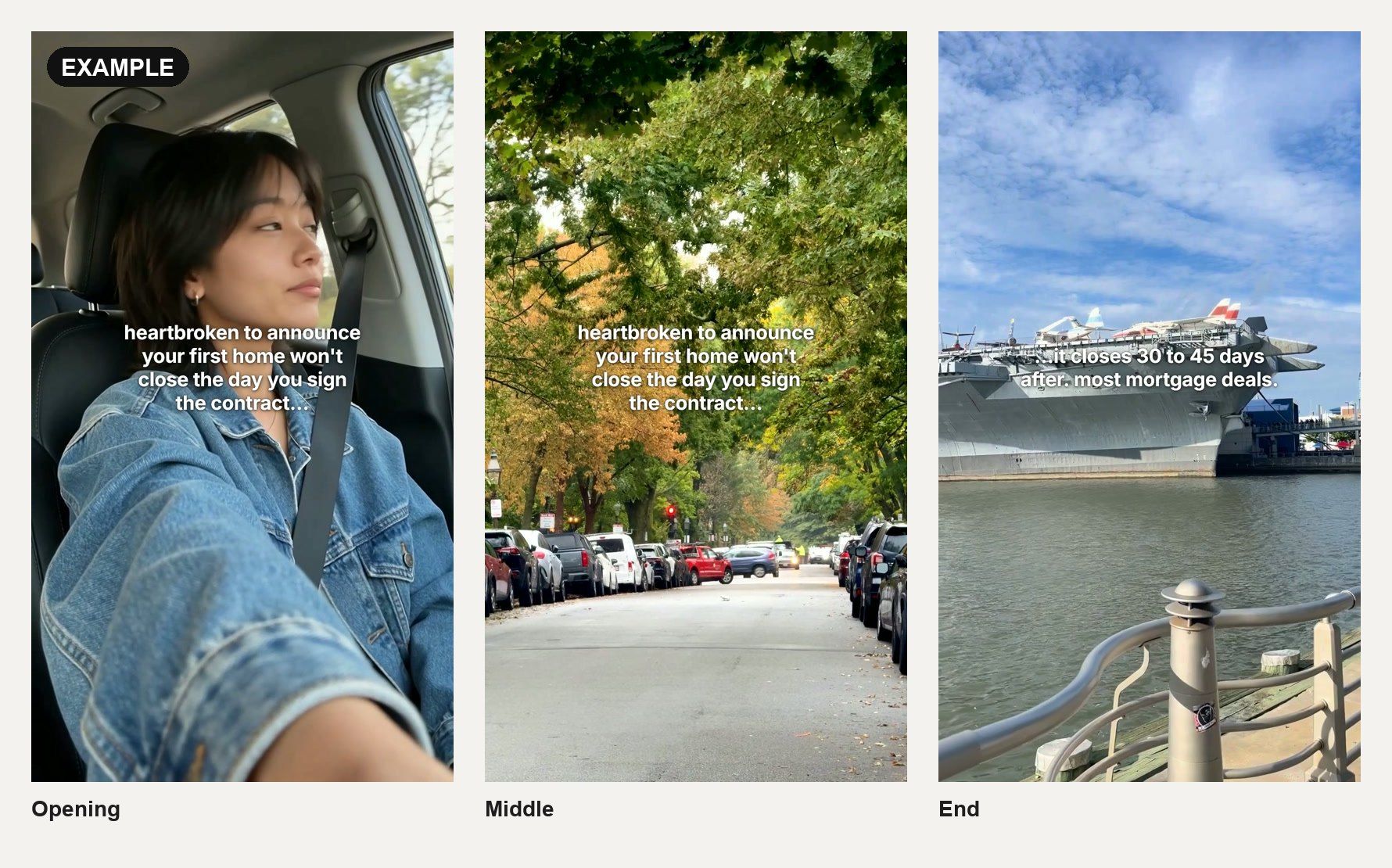
What it is. A line that sounds like bad news over a few happy shots, then a turn a few seconds in that reveals a useful fact.
When to use it. To correct something customers get wrong. It works best when the "bad news" is mild and the turn is genuinely helpful.
Structure.
- Hook: 10 to 15 words that sound like an announcement, such as "heartbroken to announce your first home won't close the day you sign the contract…".
- Beats: two or three happy shots while people wait for the turn.
- Close: the fact, in 6 to 12 words.
8. Words on black
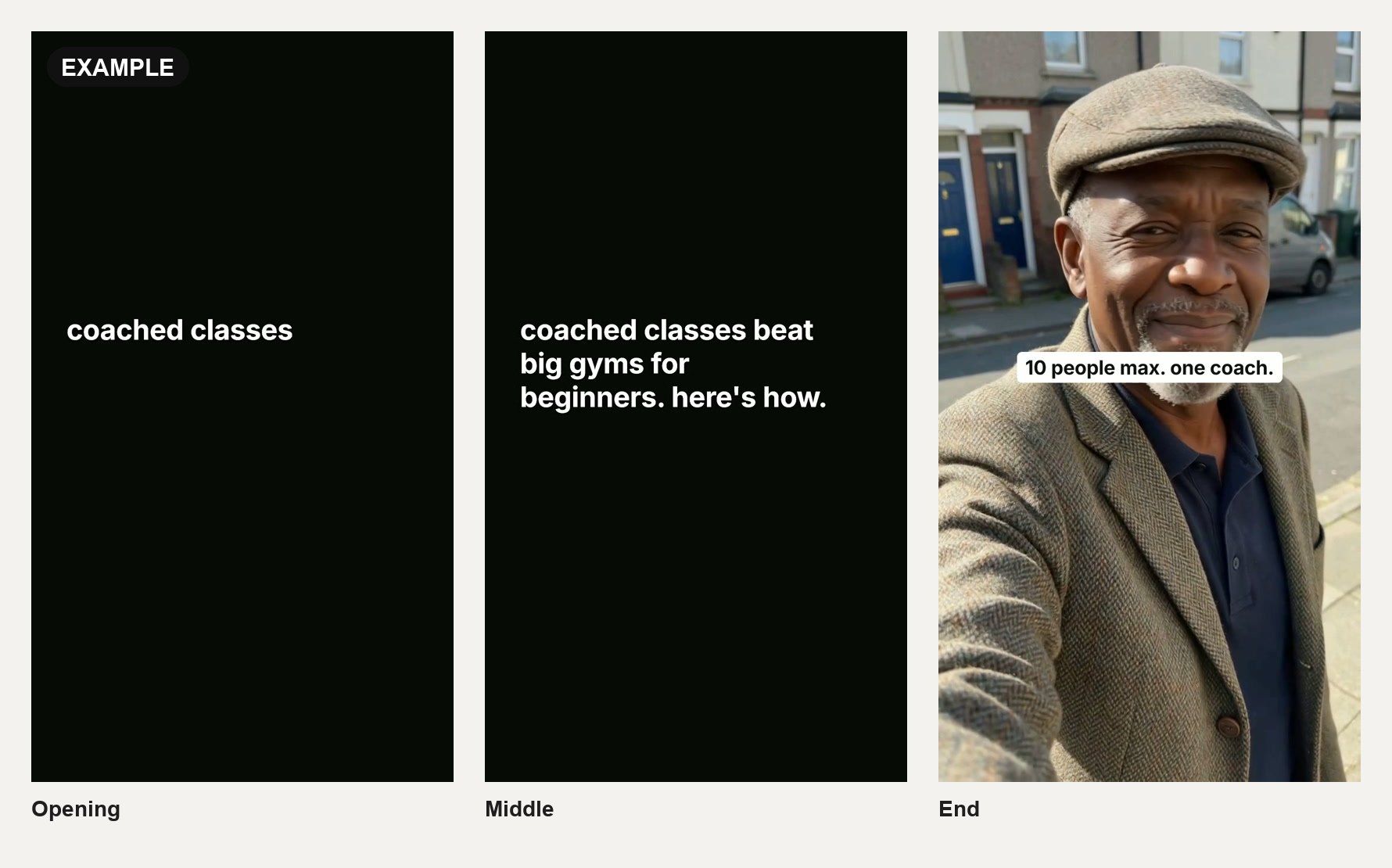
What it is. The hook types out word by word on a black screen, then cuts to a person with one proof line.
When to use it. For a bold claim you can back up. The black screen stands out in a feed full of colour.
Structure.
- Hook: 6 to 10 words, such as "coached classes beat big gyms for beginners. here's how."
- Beats: the cut to a person.
- Close: one short proof, such as "10 people max. one coach."
Reels template
The last four formats carry more than one line. Use them for steps, offers and a bit of humour.
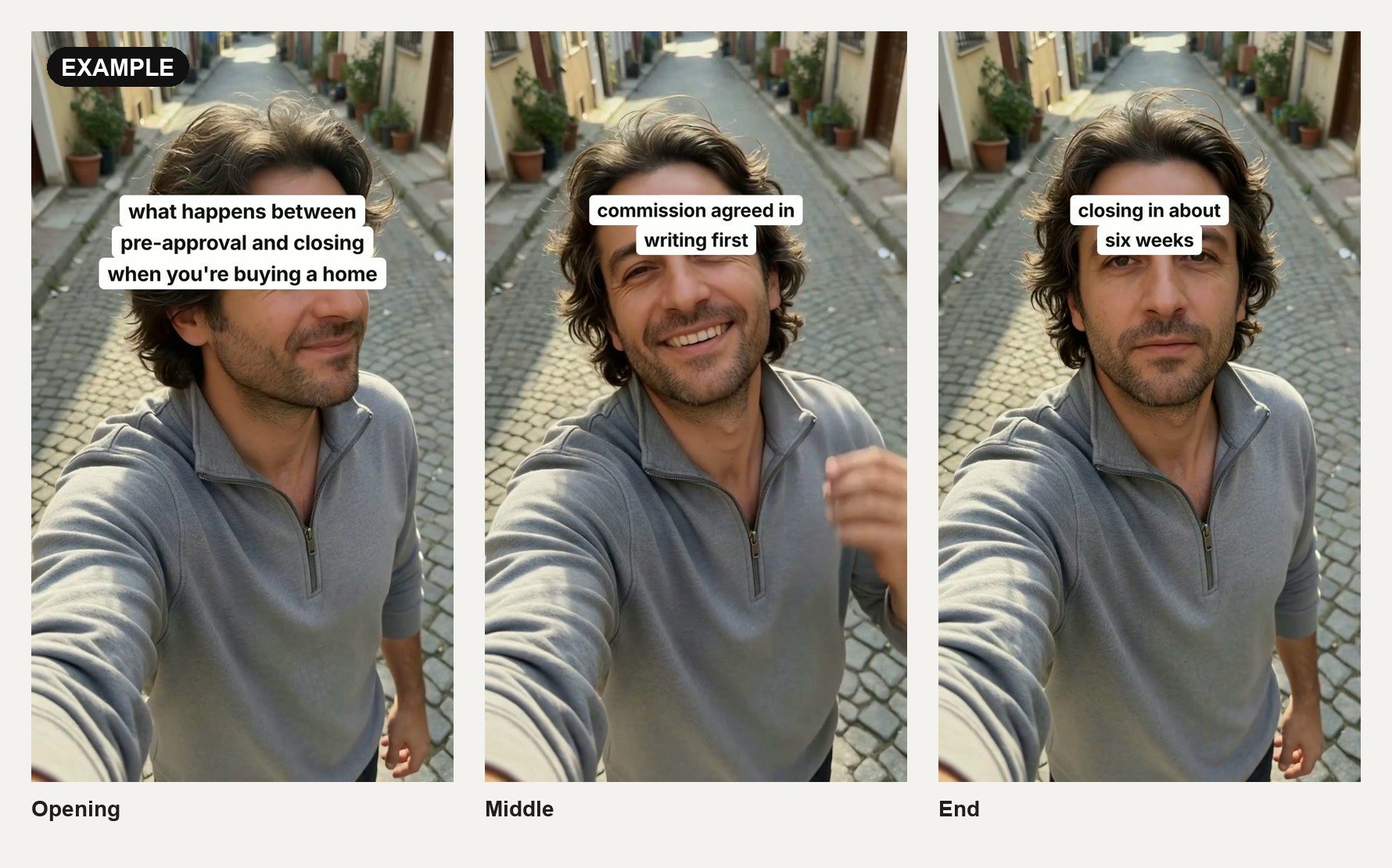
9. One item per shot
What it is. A hook box on the first shot, then one list item per shot, always in the same box in the same spot.
When to use it. For steps or what is included. Buying a home, a first appointment, what comes in a package.
Structure.
- Hook: 8 to 10 words, such as "what happens between pre-approval and closing when you're buying a home".
- Beats: four or five items of 4 to 8 words, one per shot.
- Close: the last step, ideally with a time frame.
10. Who's who, labelled
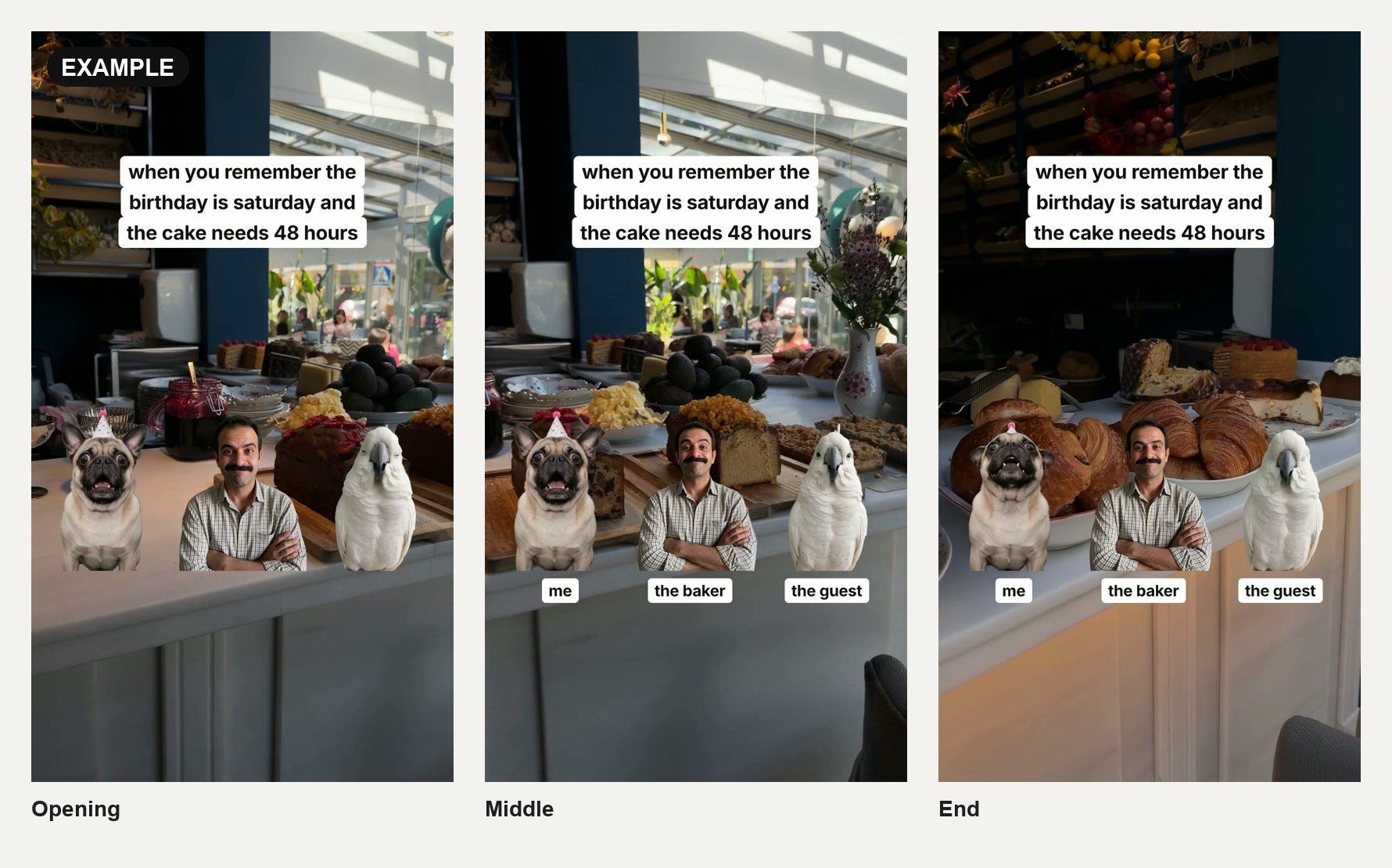
What it is. A caption box with a situation, three reactions side by side and a name box under each, such as "me", "the baker" and "the guest".
When to use it. When a moment involves more than one person: you, your customer, their guest. Cafés, trades and estate agents use it to make a rule people forget feel friendly.
Structure.
- Hook: 8 to 14 words that set up the situation, such as "when you remember the birthday is saturday and the cake needs 48 hours".
- Beats: three reactions appear, then their labels.
- Close: none needed. The labels are the punchline, and the caption gives the rule.
11. Big number and a reaction
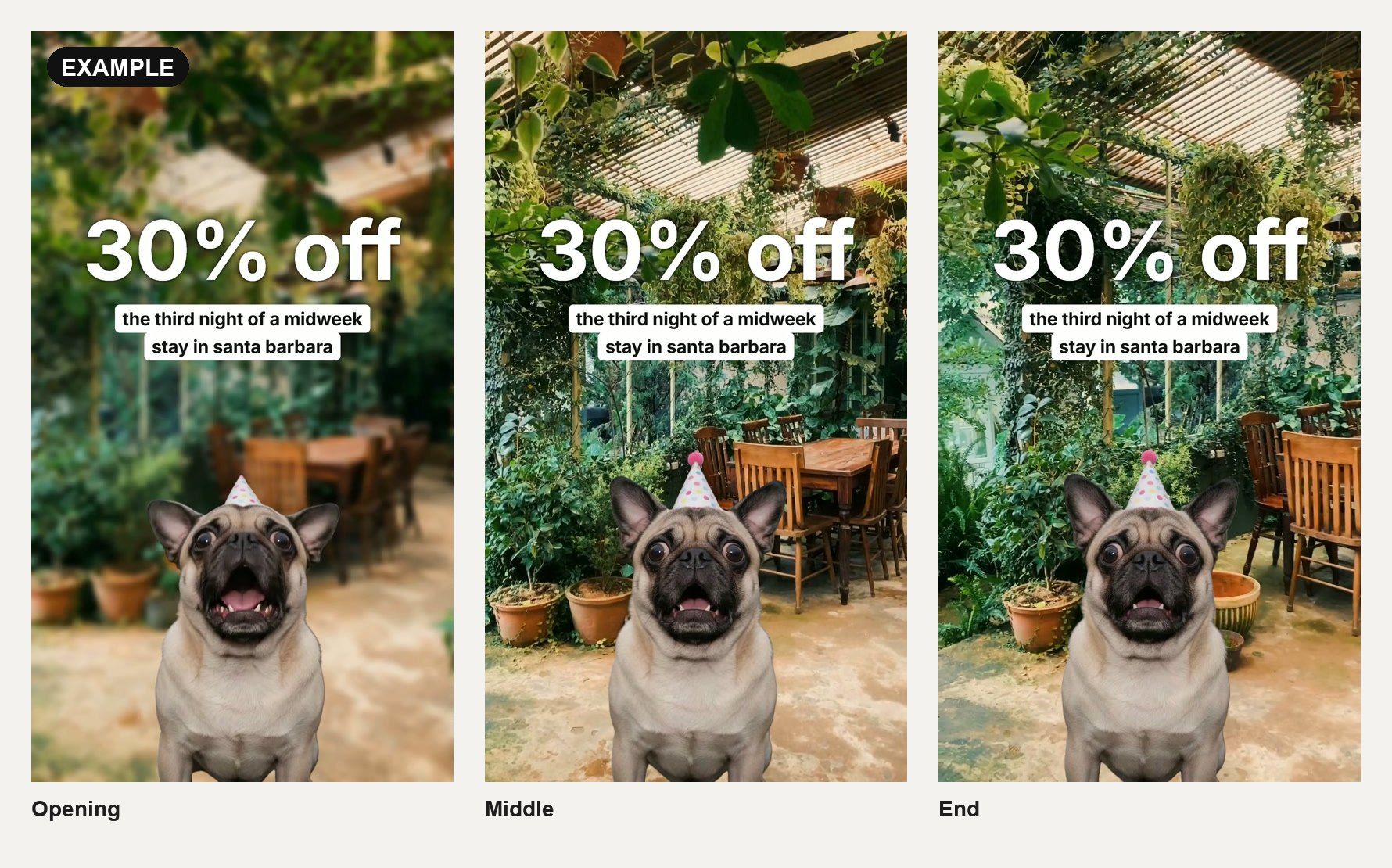
What it is. One real number from your business, huge in the top third, a short line under it, and a reaction clip below.
When to use it. For a discount, a price or a stat you are proud of. It turns an offer into something people want to send to a friend.
Structure.
- Hook: the number, such as "30% off".
- Beats: what it is, in 4 to 10 words.
- Close: the reaction holds to the end, and the caption gives the terms.
12. How it started, how it's going
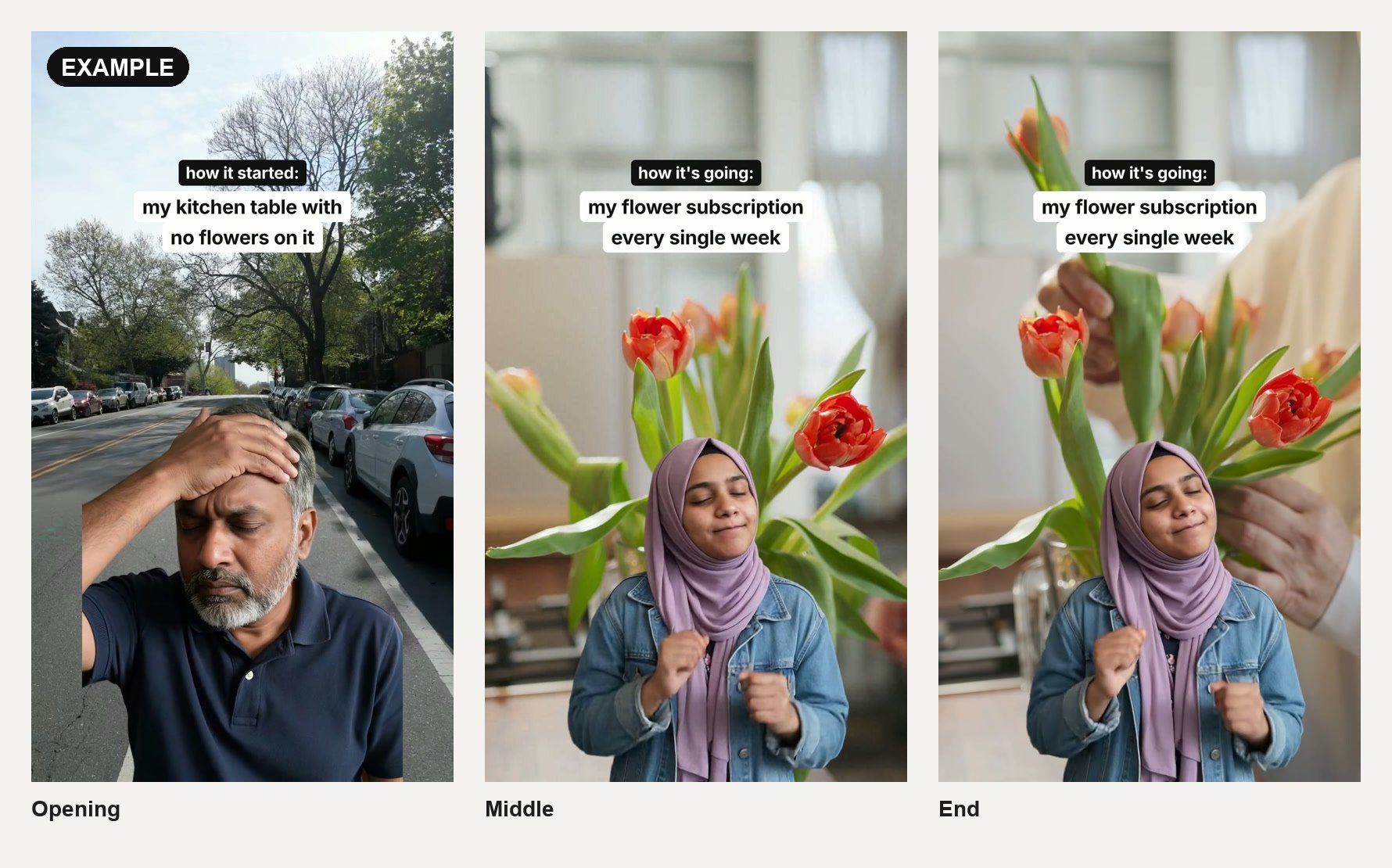
What it is. "how it started:" over a before shot with a facepalm, then "how it's going:" over an after shot with a happy reaction.
When to use it. For any before and after that your customer lives through. A bare table and a flower subscription, a messy garage and a fitted one.
Structure.
- Hook: "how it started:" plus the before, in 3 to 9 words.
- Beats: the cut.
- Close: "how it's going:" plus the after, in 3 to 9 words.
Choosing the right format
Pick by what you have to say, not by what looks clever.
- You have prices, rules or simple steps. Use a list or a wall of text (formats 1 to 3).
- You have one useful fact. Use a hook clip (formats 4 to 8).
- You have steps. Use one item per shot (format 9).
- You have a joke, an offer or a before and after. Use a reaction format (formats 10 to 12).
Then stick with two or three formats for a month. Reusing a structure is the point of a template: the words change every week, the shape doesn't. Judge each Reel against your own usual views, not against other accounts.
How Postdom fills these templates for you
Postdom makes all 12 of these formats, and more. It reads your website, picks out what a Reel can say (a price people ask about, a common mistake, a seasonal reminder) and writes the hook and on-screen lines in your brand. It then picks clips that match each line and adds an instrumental track. By default the opening shot is a person, made with AI or filmed for stock, who never speaks. You don't film anything.
You can pick a style, or let Postdom mix them. Nothing posts until you approve it. Approved videos go out at 9am and 7pm in your time zone by default, and the same video can go to Instagram Reels, TikTok, YouTube Shorts, Facebook Reels and LinkedIn. If you want a trending sound, choose to post that Reel yourself: download it, add the audio in Instagram, and Postdom takes it off the schedule. Postdom also learns from what performs, so the formats that work for your account show up more often.
The Free plan gives you 1 post a month on 2 accounts on any platform, with no card. Free posts carry a small Postdom watermark, which paid plans can turn off. Starter is $39 a month for 30 posts. See pricing for every plan.
FAQ
What is an Instagram Reels template?
A repeatable structure for a short video: a hook on screen, a few short beats and a close. You keep the structure and change the words each time.
Are these templates free to use?
Yes. The structures in this guide are free to copy into any editor. If you want Postdom to make the videos for you, the Free plan covers 1 post a month on 2 accounts on any platform.
How long should a Reel made from a template be?
Most of the examples here run 7 to 16 seconds. That fits a hook, one idea and an ending.
Do I need to be on camera?
No. Most examples here open on a person, and none of them is a business owner filming. Postdom uses AI-made people or licensed stock footage.
Can I use my own clips?
Yes. Upload a video you filmed and Postdom schedules and posts it as it is.
Which format should a new account start with?
A wall of text or a one-clip hook. Both are quick to make and work with the sound off.
Related
All posts